

What if?
By Lindsay Parrington
What if our glorious Abbey that lies in the heart of Tewkesbury had not been saved by its town folk during the dissolution? What if the lovely row of medieval cottages in Church Street, that house a number of small businesses, several private tenants and our own John Moore Museum had been demolished in the late 1930s? It could have happened…
December 1934
It has been announced that the row of medieval cottages in Church Street has been purchased by the mass-market retailer, F. W. Woolworth. A representative for the retailer said. “We have chosen Tewkesbury as the site for our latest store because we are confident this development will be mutually beneficial for the company and the people of Tewkesbury.” Mr John Moore local author and an advocate for the preservation of the town’s historic buildings has published a letter in which he condemns the proposal. He claims that the row of cottages are of historical importance and should be preserved rather than demolished.
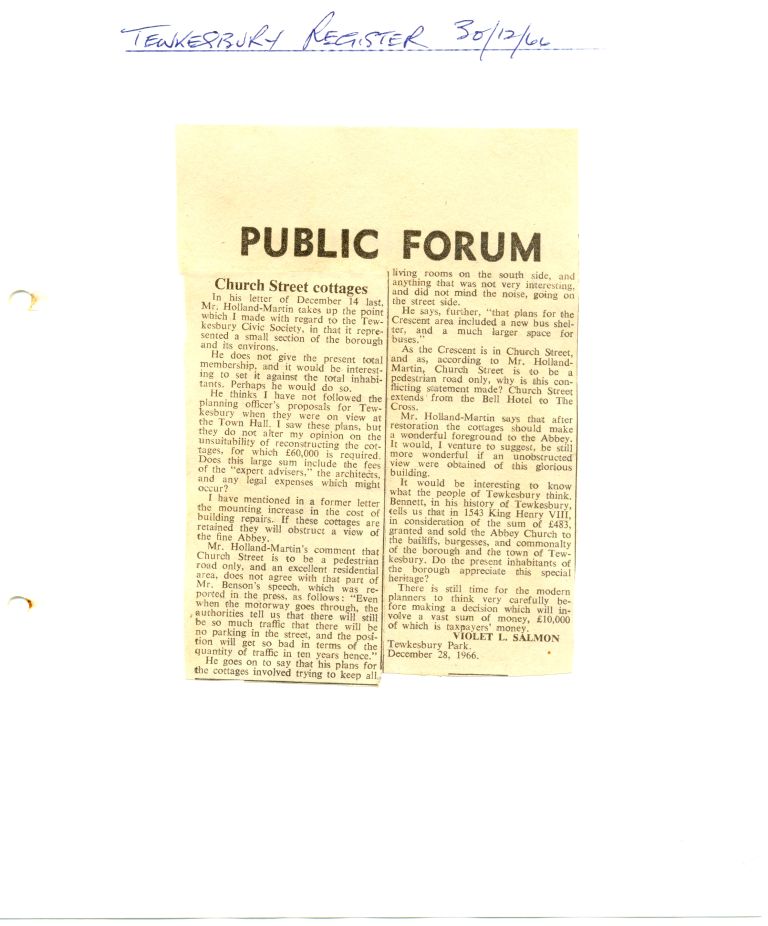
Public forum to discuss the future of the cottages…
December 1937
It seems like the whole population of Tewkesbury has turned up to attend the official opening of the Woolworth department store in Church Street. The store is on the site of a row of early 15th century cottages that had been commissioned by the monks of the now ruined Tewkesbury Abbey. There is great anticipation as the Town Mayor opens the gleaming new art deco building to the public.
Woolworths has parking for its customers, as a large portion of the old Abbey grounds has been cleared of rubble and transformed into a much-needed car park. In his speech, the Mayor thanked the Woolworth organisation for choosing Tewkesbury to build its new store, and he predicts the development will bring jobs and wealth into the town.

Woolworths Department Store in Tewkesbury
December 2021
There is much excitement in Tewkesbury today. The art deco Woolworth building, which has lain empty for the last twenty years, has become the town’s newest museum. The museum/visitor centre houses a replica of the row of medieval houses that were destroyed in the 1930s to make way for the present building. Also, there is a display of artefacts that were saved and preserved when the houses were demolished. Some of the timbers that were saved from destruction when the houses were torn down have been carefully examined and the science of dendrochronology proves that the houses were built as early as 1410. There are a number of photographs taken in the 1930s just prior to demolition on display. These photos have been invaluable in the construction of the model of the cottages.
On display is a model of the Abbey. A re-imagination of what it may have looked like in the 16th century, before it was looted by Henry VIII. Over the years, there have been many archaeological excavations in the grounds of the Abbey. A large number of the artefacts that have been recovered are on display in the museum. These treasures include several pieces of glass, thought to be part of the many stained glass windows that decorated the Abbey. One of the most important exhibits is the remains of a large stone Sun in Splendour, the emblem of Edward IV. We know from documentary evidence that the son of Henry VI, Edward Prince of Wales, was buried in the Abbey following the Battle of Tewkesbury. The stone may have been set as the centre boss above his tomb, as a symbol of Yorkist dominance over the house of Lancaster. It is hoped that the ruins of the Abbey can be preserved and further deterioration of the fabric of the building prevented. If this is achieved, it may be possible that tours of the ruins can be safely conducted, and the chain link fence that currently surrounds the Abbey can be replaced by something more appropriate, if the funds become available.

Prince Edward’s Plaque in Tewkesbury Abbey
None of this happened, thankfully, but what if……?
Postscript:
In the 1930s, the row of medieval buildings were saved thanks to the creation of the Abbey Lawn Trust Charity. They continue to preserve the terrace and the land surrounding the Abbey, in order for future generations to appreciate and enjoy them as well. If you wish to learn more about the charity’s work or would like to donate, then please contact our curator, Simon Lawton, at curator@johnmooremuseum.org or telephone 01684 297174. Thank you.
Recent Comments