

The Vardo
By Angela Dunsby
Travellers have been in Britain for over 600 years and were thought to have originated in Little Egypt which is now Asia Minor, (the term gypsy is derived from the word Egypt) but are now believed to have come from India over 1000 years ago. The Romani language originated from Sanskrit, which is spoken in India, many of these Indian words are still used by travellers today, for example: – Chavvi (Child), Grai (Horse), Yog (Fire), Gadjo (anyone outside the traveller family). Heavily persecuted throughout history, from Tudor royalty to Second World War atrocities, Travellers today are still fighting for their right to continue a traditional life and be accepted by non-travelling people, although unlike the 1500’s they are not in danger of execution for the lifestyle they lead.

Stopping place
Although many modern Travellers are now settled on permanent sites, many continue to lead a nomadic lifestyle and are trying to preserve a tradition, which is becoming more difficult due to prejudice. According to the 2011 census, ¾ of Travellers were living in bricks and mortar; however, this is only an indication of those that took part. It is always a wondrous sight for me to see a traditional vardo or horse-drawn-wagon slumbering along a country lane or camped in some peaceful location, campfire smoking languidly as the weary travellers prepare meals and enjoy the open air. New age Travellers can often be confused for traditional Travellers as they embrace the nomadic lifestyle and endeavour to be free of the constraints of house dwellers.
Travellers in England used the first wooden horse-drawn covered wagons in the 1830’s during the reign of King William IV and by the 1890’s the wagon in Britain had developed its own character, both functional and distinctive. It was also at this time that the Romanies were the greatest users of mobile homes and this trend continued for 60 years, the decline in wagons began in the mid-20th century when many younger Travellers took to using motorised vehicles and began a new trend with permanent sites appearing around the country. The Willows near Sandhurst, Gloucestershire, is an example of an official unit. This change was in part due to the difficulty in finding camping places where they would be unmolested by the non-Traveller community, it also allowed them to travel much further and to carry more items, (the diary of a gypsy girl from 1911 states how the family only covered about 6 miles a day). The older generation could not adjust to these changes and many, for nostalgic purposes, started to make models of the old vardos. Romanies refer to their homes as wagons, vans or vardos, house dwellers call them Traveller caravans, but however you refer to them, they were designed to be a complete home for a family, furnished with all the accessories required for daily life, this would have included pots, pans, clothes, kettles and baskets of food. Considerations had to be made for the horse expected to pull the vardo, everything had to be stored in a safe and functional way. The family often lived in bow-top tents or “benders” during their travels, which they erected in lanes when they stopped. The vardo was a very valuable item and a symbol of wealth and status which is still recognised today.

A family outside of bender tents
The first Romany wagons were a smaller two wheeled pot cart and were termed as sleeping carts. These carts had a canvas covering which rolled down at the back and were entered at the front, between the shafts. Not all vardos are of the bow type most of us recognise and which were made in the Midlands, Lincolnshire, Yorkshire and Scotland. Depending on the external shape of the framework, we can also find barrel, bell and square topped wagons. These wagons have no side windows but often have an oblong rear window and front half-door. The bow top was a light vehicle with narrow and elegant wheel rims. The doors opened outwards, essential with such limited internal space. Although not seen much in the south of England, a number of them crossed to Ireland and were used by Travellers or tinkers. Irish Travellers were often called “Tinkers” and this is a reference to the sound of a hammer on an anvil or an artisan sharpening scissors or knives. They were also popular in Wales and Scotland. As time passed, wealthy Irish Travellers ordered these from England. On both sides of the Irish Sea, square bows were often bodged or built by their owners, to cut down costs and perhaps to show off building skills with varying results. Between the two world wars, some were made to order, some having straight sides with small windows near the centre of each side.

Painted vardo
The most luxurious style of Romani van or vardo is the Reading van, so named as they were made by Dunton & Sons in Reading, Berkshire. In the 1880’s they were a cumbersome vehicle, and it was only after several years that a design fault became apparent. Due to the heavy rear end, the bodywork would begin to arch. This was a very expensive problem to correct. Although named after the town of its origin, these troublesome vans were made in several parts of Britain by most leading van makers. Some vans were homemade and called an “open lot”, this was because of the lack of a door but rather an open front covered by a sheet similar to a tent.
Most cooking was done outside although many vans had a stove inside for warmth. For lights, paraffin lamps were employed, although these carry many fire risks if not used correctly. Churns and stainless-steel buckets were used for carrying water and campsites would have been chosen with water availability in mind. Many Travellers were known to remove a wheel from the vardo and pretend it was being repaired, thus allowing them to stay where they were.

Travellers were extremely good at supporting themselves and turned their hand to many skills in order to provide for the family. Some of the jobs they did were pea-picking, sugar-beet hoeing, potato picking, making pegs, reading palms and selling lucky charms. Often, gypsies were paid in trade with food and clothing from the people enjoying their services.
To display their brightly covered wagons, most Travellers travel to the great fairs of England. Edward VI granted a market charter to Stow on the Wold in Gloucestershire and the fairs continue to this day, being held in May and October each year. The Appleby horse fair and market starts in June and has existed since 1685. This is the most important fair on the traveller calendar as much trading occurs here and horses are bought and sold for great sums of money. The fair is also a good opportunity for Traveller communities to socialise, and for younger generations to find a suitable partner.
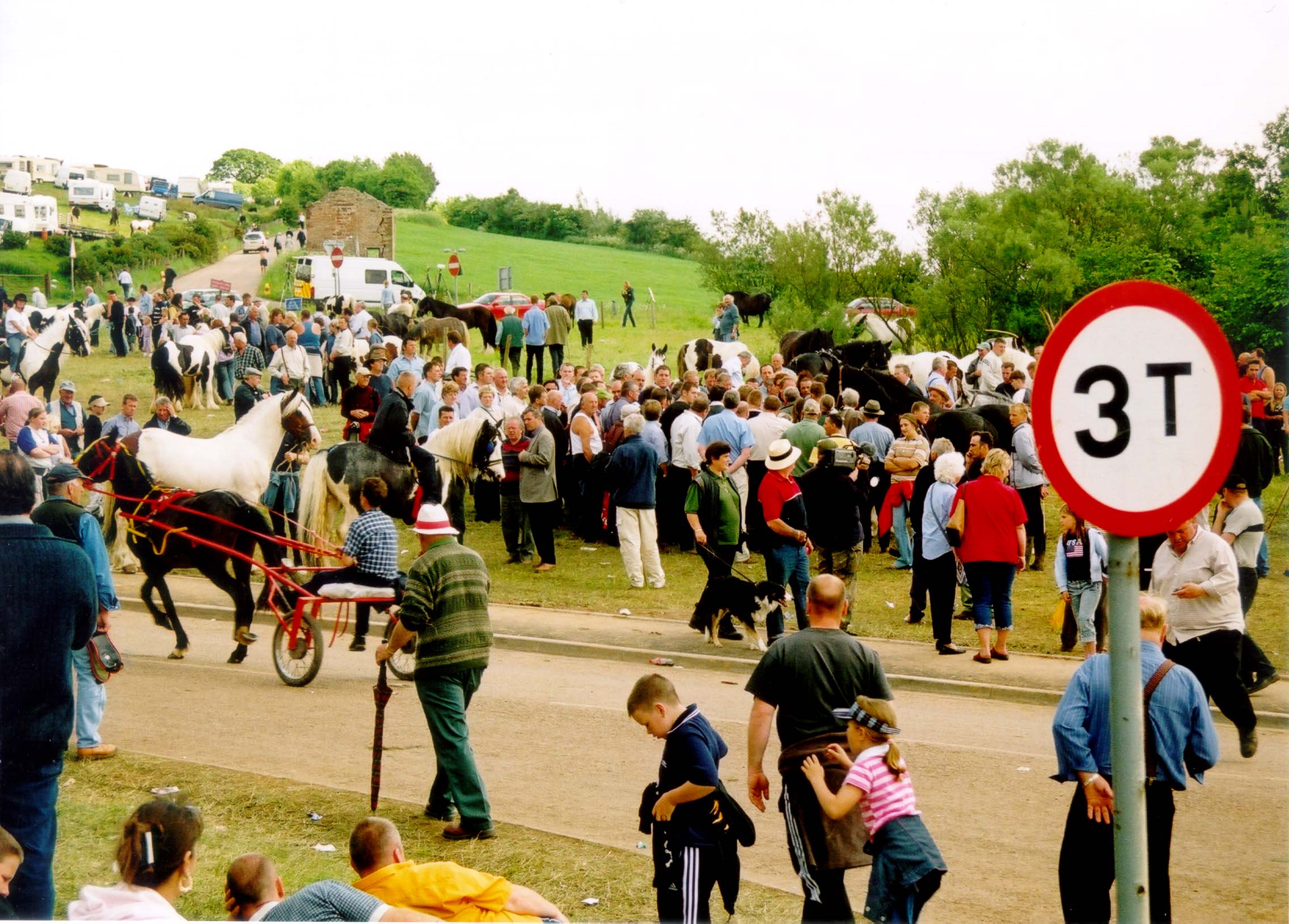
Appleby Fair
Travellers found a continued issue with access to health care due to their nomadic lifestyle and so created their own medicines, possibly passed down from ancestors. The list below explains some of the cures they used, and I personally think they sound very medieval!
Colds-mixture of onions, brown sugar and syrup
Cuts-elderberry leaves and lard, leaves fried in lard and put into pots.
Baldness and eczema-Cow dung
Earache-Hedgehog fat
Sticky eyes-Tea bags or cold tea
Infected wounds-Dock leaves put in hot water and laid on wound
Many of these remedies have been used for centuries by housewives. Onions were often used for treating wounds and burns. Elderberry leaves were used to treat ulcers on the legs, and yellow dock root was used in the treatment of cholera.
In the event of death, the tradition is to burn the belongings of the deceased, this included the vardo, although today, it is more usual to burn a few of the dead persons belongings in a symbolic nod to the old traditions.

Wooden Vardo Model in the museum’s collection
John Moore Quotes:
At The John Moore Museum, we have a great respect and fondness for the travelling community as did John Moore himself, and I feel it is only right that I leave you with a few excerpts from “September Moon”, a book in the John Moore collection.
“The hop-pickers provided the chorus, miners on holiday from Wales, factory workers from the Midlands, gypsies and half-gypsy “travellers” all thrown together against the green frieze of the hops under the hot sun”.
“This second caravan was filled with the assorted brats of Wisdom, all ages, lean rangy youths and elfish looking little boys and girls who peered out of the windows with wary, secret and appraising eyes, like wild things in a cage”.
“He was slashing at the flanks of the high-stepping pony, standing up and hanging on to the reins, while the caravan swayed and the buckets slung from its tailboard, rattled and banged together”.
“The road, like all the little roads of Herefordshire, went round the Haycock Hills or between them, trickling like a stream, easy-going folk had made the road, not single-minded and purposeful like the Romans, but men of the West who saw life as a winding lane”.
“He wondered what twelve months meant to you if you lived as the gipsies did, having no fixed point in your life, drifting to and fro… perhaps time for them was a tally of places, Worcester for the pea-picking, Shropshire for the cherries, Evesham for the plums, Hereford for the hops and so on.”
Dear John Moore Museum. Enjoyed your article on Vardos, and related information. I have accumulated, over the years, a great many books, and other material, re the Romany way of life, including an open lot, which sits in the garden. Keep up the good work. Cushti !
This has enriched my plans going ahead in my life with hints of historical zeitgeist.