
The Meaning behind the Badge
By Kirstie Bingham
We have been wearing badges, tokens and symbols for thousands of years, and even today, you will see people wearing a badge on their coats, hats and bags. Perhaps they want to show their connection and allegiance to a certain group or perhaps this symbol is a lucky charm to ward off bad luck. Whatever the reason, this badge holds some form of significance and meaning, which is why they want to show it off. Our ancestors were the same. In the museum’s collection, we have a series of replica badges from the medieval period, and I want to share some of them with you.
The Pelican Badge
 In the Middle Ages, the pelican was understood as symbol of Christ’s sacrifice, dying on the cross to save mankind. In times of food shortages, mother pelicans were believed to pluck their own breasts to feed their dying young with their blood, saving their lives. In the process of feeding, the mother would die. As a result of this, the pelican became a symbol of piety and motherly love. This potent symbol became a favourite of Elizabeth I, and she used it to represent herself as ‘mother’ to her Protestant nation. In 1575, Nicholas Hilliard painted the Queen bearing the pelican symbol to emphasise her dedication and commitment to her subjects.
Fox and Goose Badge
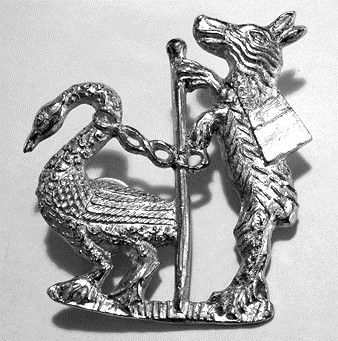 There is more to this badge than first meets the eye. This is a piece of clever religious propaganda. The fox is dressed as a pilgrim with a pilgrim’s staff and scrip and apparently, he is taking a goose for a walk. The fox was regarded as the archetype of cunning and deceitfulness, while the goose was a proverbially foolish bird. Here the fox seems to have tricked the goose by disguising itself as a pilgrim and is presumably leading the goose to its ultimate fate! The Puritans also used this badge, with the fox representing a priest in a pulpit, enslaving the goose in the chains of his false doctrine.
The Yale Badge
 The Mythical Yale was first described by Pliny the Elder as an antelope type of beast with large tusks and the ability to swivel its horns independently. The Yale badge as you see here was adopted by the Beaufort family in the early 15th century. In 1525, the badge was granted to Henry Fitzroy, the illegitimate son of King Henry VIII. The Yale is one of the heraldic beasts used by the British Royal Family today. Others include the lion of England, the red dragon of Wales, the unicorn of Scotland and the falcon of the Plantagenet family.
The Cat and Mouse Badge
 The cat and mouse badge bears the inscription visis mu (‘here is the mouse’). It was a common image at the time, often found in medieval bestiaries and misericords. Its meaning is unclear though it may have been an allegory for the Devil catching sinners. Strangely, the cat has two tails. Although the number two can symbolise sin and the corruptible, the exact meaning of the two tails is mysterious.
The Owl Badge
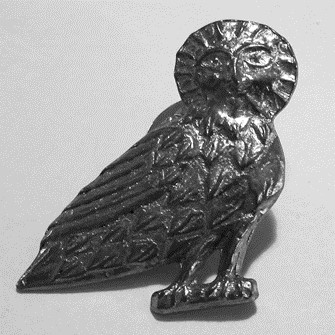 All medieval badges were worn for a reason, but this one is difficult to interpret. In medieval symbolism, the owl was principally used to represent sin, the Devil or the Jews, who supposedly preferred darkness to the light of the gospel. There was also a belief that the souls of murdered victims were trapped in owls, and their nightly shrieks were their demands for justice. So with all that in mind, why do think someone would choose to wear this badge?
The Crowned Heart Badge
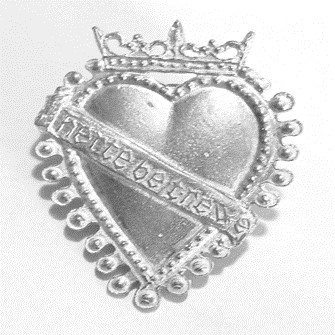 The crowned heart with a diagonal band bears the inscription herte be trewe. The heart is surrounded by pearls to represent purity. This badge would have been worn by women more than men. Queen Elizabeth I had many items of clothing adorned in pearls, as this reinforced her image as the pure, Virgin Queen.
A Gift of Flowers Badge
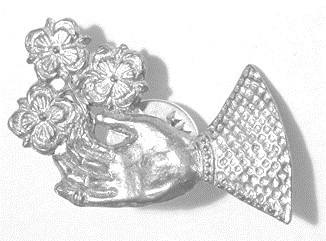 This lover’s token depicts a hand wearing a double banded lover’s or gimmel ring (look closely at the little finger) and proffering a bunch of quatrefoil flowers, symbolic of the true-love or Herb Paris. The plant’s name is derived from the Latin pars, meaning “equal,” describing the symmetry of the four leaves arranged in a whorl around the single stem. The pairing of the leaves also suggested the pairing of lovers. The Herb True-love was the ultimate lover’s flower of the Middle Ages, and it would have been given and worn as a symbol of love.
There are more badges within our collection, but I hope you have enjoyed this introduction to our medieval badges and their symbolic meanings. The next time you are out and about, take a closer look at the badges you can see being worn today, perhaps there is a hidden message waiting for you to decipher it.
Recent Comments