

The European Hedgehog – (Erinaceus Europaeus)
By Angela Dunsby
The European hedgehog is a spiny mammal of the Erinaceidae family and is native to Europe. I am sure we are all familiar with our native hedgehog, but there are in fact seventeen species of hedgehog around the world, found in Africa, Asia and New Zealand, where it was introduced in the 19th century.
Hedgehogs grow to around 20-30cms and weigh approximately 1-2kg. The lifespan is about 2-3 years, but this can be longer if conditions are favourable. Hedgehogs have on average four to six hoglets in a litter, but can have as many as ten.The gestation period is about 35 days. They are typically born early to late summer, and any litters born later than this, can struggle to be ready and fat enough for the winter hibernation. Hedgehogs only produce one litter a year, and are taken care of solely by the sow with the boar having no involvement. Unfortunately, boars can eat the young if they are allowed near, having said that, the mother is also capable of eating her own young if she smells something untoward, such as, if the babies have been handled by humans. Young hedgehogs are called urchins or hoglets but we will come to that again later. The hoglets are born in a maternity nest with their eyes and ears closed, these will open after about 14 days. The teeth come in around day 21. The first spines are white and covered in skin. The spines are made from keratin like our nails and hair, and there are roughly 6000 on the majority of the body, but are absent on the underside and face. These spines provide protection from any threat, so the hedgehog will roll into a ball allowing its spines to stick out as protection. They are able to leave the nest at 4 weeks, but do not become independent until they are about 8 weeks old. Hoglets make a high piping sound when distressed, which is often mistaken for the call of a bird, this alerts the mother who will then try and cause a distraction to lead danger away from the nest. Sexual maturity is reached at 12 months old and a new generation can begin.
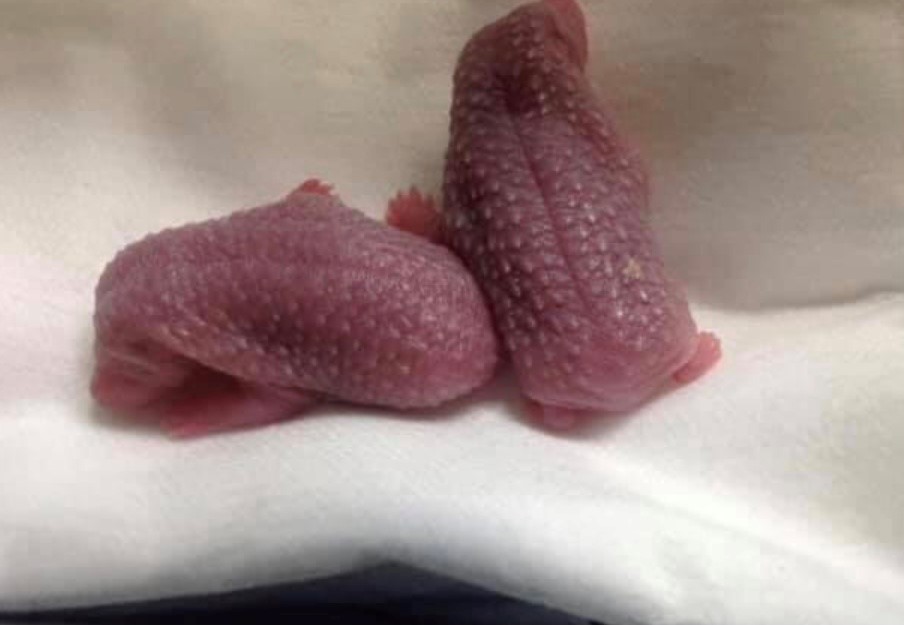
Tewkesbury Hoglets
Hedgehogs have extremely poor eyesight and rely on their excellent hearing and smell to hunt for food or sense for predators. They have up to 44 teeth, which they use to eat their diet of invertebrates, including slugs, snails, insects, dog or cat food, but never milk as they are lactose intolerant. Hedgehogs are one of only three mammal species to hibernate in the UK; they are also nocturnal and are known to travel for up to 2 miles a night looking for food or nest material. If you see a hedgehog out in the daytime, it is probably in trouble, although caution should be taken if you consider helping the animal especially in the summer, as they are often looking for nesting material and extra food for hoglets. Hedgehogs hibernate from November until March, and need to feed well before this time.
In hotter countries, the native hedgehogs will sleep during heat and drought (this is called aestivation)in the same way that our cold climate hogs hibernate during the cold season.
A group of hedgehogs is called an array, although it is unusual to see more than one hog at a time. Did you know that hedgehogs have host specific fleas, which live on nothing else? Hedgehogs can be found living in woodland, meadows and grassland, they are also found living in household gardens where they can come into contact with humans, but not always in a positive way. Apart from the usual predators such as badgers and foxes, the hedgehog is often the victim of human hazards such as cars, bonfires (where they may be nesting), lawn mowers, strimmers and garden ponds to name a few. Lungworm is also a killer of hedgehogs, particularly in autumn and winter. Hedgehogs are in serious decline due to the change in the natural environment caused by pesticides and loss of habitat through farming procedures and the increasing urbanisation (a problem which greatly concerned John Moore).

Poor Badger Victim
The earliest word for hedgehog is the Anglo-Saxon word “Igl” which is Germanic and is still used in Germanic languages today, for example, the Swedish word is “Igelkott”. Around 1300 AD, the old north French word “Yrichon” came into use and the term Urchin started to be used to describe anything that resembled a hedgehog. In the 1520s this applied to hunchbacks, bad girls in the 1530s and goblins in the 1580s, although around 1450 the word “Heyg Hogge” came into use, literally meaning hedge and hog as they were often found in hedges and had a hog like snout.
In Tudor times, the hedgehog was almost hunted to extinction, as they believed they suckled milk from the teats of recumbent cows at night, which we now know not to be true. The “Preservation of Grain Act” passed in 1532 by Henry VIII and later strengthened by Elizabeth I in 1566 made it compulsory for every man, woman and child to kill as many creatures as possible that appeared on the vermin list. All parishes were made to pay a levy to a bounty hunter to hunt hedgehogs along with other animals including badgers, foxes and ravens. Communities were punished for non-payment of this levy. Thankfully, the act was finally repealed in the mid-18th century after the realisation that their destruction also had a huge impact on the fauna and countryside of Britain.

Medieval Illustration of a Hedgehog
Silly note: The Irish word for hedgehog is “Gainneog” which means, “Ugly Little Thing”, which I could not agree with less.
We hope you have enjoyed this blog on one of the UK’s most adorable and recognisable mammals. We have several hedgehogs within the museum’s collection (all ethically sourced), and you can even handle one of them, although beware, he is a tad prickly!
Recent Comments