

Some Unfunny Humours!
By Angela Dunsby
In these difficult times, it is easy to forget just how lucky we are to have made such huge advances in medicine. We have superb doctors with scientific knowledge guiding them towards new treatments and cures and I am sure that even when we are frustrated with situations such as the current covid-19 crisis, we can be assured that we are unlikely to receive anything, but the best and most appropriate treatment required.
As advanced as modern day medicine is, the past holds a quite different aspect to health and wellbeing. We must go back in time to around 400bc where we find Hippocrates, a Greek physician from the Roman Empire who added characteristics to bodily fluids. He believed that the fluids in the body needed to be kept balanced in order to maintain good health and mental stability. In short, they were chemical systems regulating human behaviour. Hippocrates applied these theories to medicine in order to treat health disorders. Fellow physician, Galen, further developed these theories and created links with the humours and the different organs of the body and the connection to conditions such as warm, dry or cold. These methods were applied for hundreds of years and only fell out of favour in the mid to late 19th century with the advent of germ theory which was developed by such people as English surgeon Joseph Lister and later German physician Robert Koch and French chemist Louis Pasteur.
The four humours (humour is a translation of the Greek word ‘Chymos’, literally meaning juice or sap) consisted of Blood, Phlegm, Yellow Bile and Black Bile, sounds delightful, doesn’t it?! Each of these humours, as with many ancient ideas, were also aligned with cosmology, with blood being linked to spring, yellow bile to summer, black bile to autumn and finally phlegm to winter. Just to make it even more complex, each humour was also aligned with environmental conditions, phlegm related to the cold and damp, black bile to cold and dry, yellow bile to warm and dry and blood to warm and damp. An imbalance of humours was called dyscrasia and was thought to be the cause of all diseases, once balanced you achieved eucrasia.

The fundamental concept of the four humours relied heavily on these four fluids and were believed to exist in cycles according to the seasons and constellations. This meant that a winter illness might be considered as an imbalance of phlegm, which caused respiratory and breathing difficulties. Summer illnesses were associated with yellow bile resulting in fever and liver disorders. Treatments were based on opposites to create balance. So, to counter an over saturation of phlegm associated with the cold winter, it would be treated with hot substances, likewise warm illnesses were treated with cold treatments. If someone was hot to touch, then they probably had too much yellow bile as it is the summer humour.
Just to further complicate things and test my explanatory skills, the humours were also thought to affect temperament and character.
A prevalence of blood would result in a person being Sanguine. These people were energetic, creative and enjoy being noticed. They were courageous, hopeful and amorous (hot blooded!). An excess of sanguine symptoms might create a terribly angry or over amorous person, which could result in sweating and fever in the patient requiring blood letting by such methods as scarification, single cuts and leeching which, incidentally, is still seen in some areas of modern medicine. Although not used widely today, the leech is still used in some areas of post-surgery to improve blood flow and prevent the clotting that can occur after surgery, in particular re-constructive and cosmetic surgery. Leech saliva contains up to 15 anti-clotting enzymes and proteins which promote blood flow and healing. During medieval and Tudor times, there was an industry to collect leeches here in Britain and in fact there is a Welsh farmer near Swansea who is currently an exporter of leeches to many other parts of the world. Leeches used for medical purposes are known as “Hirudo Medicinalis”, they are specially farmed for medical use.
Too much black bile created a Melancholic person. The melancholic person was a thinker and perfectionist who also preferred time alone. Considered to be creative in music and poetry but prone to depression if things were not right. The symptoms of too much black bile were that the patient became depressed and gloomy; doctors would force a sufferer to purge or vomit frequently using the hellebore plant to attain this. Perhaps this could be the origin for someone being in a black mood! Next time I’m feeling grumpy I might try chomping on my hellebores, but then again, perhaps not!

Four Humours in Human Form
A Choleric person was influenced by yellow bile and would display bossiness and bad temper, but were also ambitious and critical. Too much yellow bile could cause a person to be easily angered or annoyed, yellow bile is connected to the gall bladder and urine so could explain why we say someone is “pissed off”. Too much choleric behaviour might be treated with camomile tea, which again is still used today for its calming qualities.
Finally, we have the Phlegmatic person, a quiet, kind and peaceful character wanting to give and receive affection, going with the flow yet often shy; a phlegmatic person is cool, calm and unemotional. Too much phlegm (its phlegm folks but not as we know it), could cause coughs and colds or even energy problems. This was treated with fluids and stress reduction, and was not considered as serious as the other humours.
In order to determine how the humours were imbalanced, physicians used the method of uroscopy which is the visual examination of a person’s urine to detect pus, blood or other indicators of imbalance. Physicians would use a special flask called a Matula, this was a transparent glass receptacle which the patient would pee into so that urine could be examined with the eye first. A urine wheel was used as a way of identifying diseases, it usually had twenty different coloured uroscopy flasks around the border of a circle with indicator lines pointing to a particular disease that might be indicated by colour alone. A patient with a brownish tint to their urine might be diagnosed with jaundice and could be indicative of an excess of black bile and melancholy, whereas if the urine was red or foamy this might indicate kidney disease. The aroma test was also used, where a sweet smell might indicate diabetes and a musty smell could indicate infection. Unfortunately, it was also deemed useful to taste urine as there are certain indicators that can help in the diagnostic process, but I would prefer not to dwell on the matter.
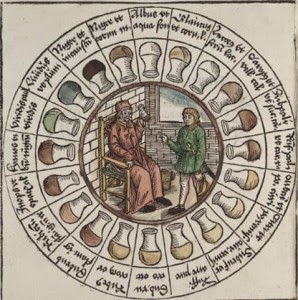
Urine Wheel
All in all, times have changed, and I think you will agree, improved greatly. Simple medication and treatment are so readily available to the modern world and I for one am incredibly grateful that I don’t need to be leeched every time I get a bit cross or forced to feed and purge on my garden plants every time I feel a bit sad. I hope my blog is easier to read and understand than it was to write, I need a camomile tea!!!
Recent Comments