

“Off with their Heads!”
By Kirstie Bingham
The phrase “Off with their heads!” always conjures up in my mind the image of the Queen of Hearts from Alice in Wonderland by Lewis Carroll. However, the phrase by no means belongs to her, and our medieval monarchs were using the phrase too. We cannot forget that Henry VIII is renowned for beheading two of his six wives. This blog will look at some of the more unusual victims of this phrase “off with their heads” in the Tudor period.
Under Henry VIII in 1532 and again under Elizabeth I in 1566, Parliamentary acts were introduced to kill a whole range of animals that were considered vermin. These laws meant that thousands of animals, ranging from crows to kingfishers, were slaughtered because they were seen as being in competition with people, especially for food. Let us now look at some of the wildlife that was hunted for money under the Tudor Vermin Laws.
The Badger
 Badgers were once regarded as courageous animals, and warriors used to carry a strip of badger fur into battle, so they could be imbued with the strength and courage of this animal. However, this did not prevent them from being added to the Tudor hit list. Badgers were hunted mercilessly for sport, but also because they were believed to steal chickens, kill young lambs and take eggs from birds’ nests. Furthermore, the Tudors disliked their big underground setts, which could undermine the edges of fields and destroy land that could be used to grow crops. As a consequence of this, a single badger’s head was worth 12 pennies or 1 shilling.
The Bat

For centuries, bats have long been misunderstood creatures with a bad reputation. They have been accused of being associated with ghosts, witches and demons because of their nocturnal nature. This supernatural link with evil made them perfect targets for hunting, and a cash bonus of 1 penny made it even better.
The Crow
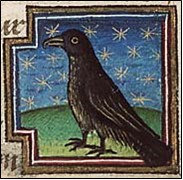 Crows were the primary targets in the early Tudor Vermin Laws. The Law of 1532 was specially aimed at reducing the number of rooks, crows and choughs [jackdaws], in the hope of protecting the grain harvests, which had been poor. The law states:
“For as much as innumerable numbers of Rookes, Crowes and Choughs do daily consume a wonderful and marvellous great quantituy of corn and grain of all kinds … as well in the sowing … as also at the ripening and kernelling … and over that a marvellous destruction and decay of the covertures of thatched houses, barns, ricks and such like.”
Fulfilment of this act required that:
‘Every One shall do his best to destroy Crows etc… Every Town, Hamlet of more than ten dwellings (is to) provide and maintain Crow-nets during ten years. The inhabitants shall during ten years assemble and take order to destroy Crows, Rooks etc.’
By this Act, local communities were required to provide nets for catching these birds and to meet annually to review the work and decide how to succeed in killing all the young. The standard method of hunting was an early form of clap net, which had been baited with corn. The net was laid flat on the ground, and a cord was pulled to snap the net close once enough birds were feeding there.
Despite the strong emphasis on catching crows, the financial reward was not high, only 2 pennies per dozen heads.
The Fox
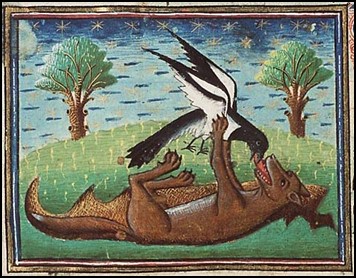
The fox has had a reputation for mischief and thievery for a long time, and has been widely despised for killing chickens, lambs and piglets. The method for catching the foxes in involved netting the sides of a copse and then driving the fox with any available dogs until it ran into the net. Here it was brutally killed with sticks and cudgels. A fox’s head in 1566 could earn you 1 shilling, which is equivalent to £12.00 in modern money. This was a significant sum, which indicates how much the Tudor monarchs desired to control and potentially eradicate this animal.
The Hedgehog
 Today we welcome the sight of hedgehogs in our gardens, but unfortunately, our Tudor ancestors did not feel the same way about these prickly guests. In Tudor times, people thought hedgehogs drank cows’ milk straight from the udder whilst the cows slept. We know now that hedgehogs are lactose intolerant, which is why we should never put out a bowl of milk for them, so this is definitely one Tudor myth that can be broken. Hedgehogs were also accused of creeping into hen houses to steal eggs. These two crimes made hedgehogs a pest worthy of eradication, and a hedgehog head would fetch the price of 4 pennies (approximately £4.00 now) in most parishes. Hedgehogs are not particularly difficult or dangerous animals to catch, so many people made easy money catching them.
The Kingfisher
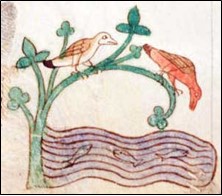
In some parts of the world, it is considered lucky to see the vibrant flash of blue and orange of a kingfisher, but of course, our Tudor ancestors thought differently. Kingfishers were also included in the Vermin Laws, and in 1566, you could receive 1 penny for a head. The Tudors ate fish several times a week because of Church Law, so any creature that dared to eat their food source had to go.
The Otter
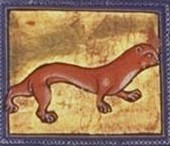 The Tudors despised otters since their diet made them prime competitors with humans. Otters will hunt for fish, amphibians and small birds in and nearby rivers and established fishponds. Therefore, Elizabeth I included otters in her 1566 Vermin Act, and throughout many English counties, churchwardens paid 12 pennies or 1 shilling for an otter head. The Tudors also hunted otters for sport, and could thus entertain themselves and get richly paid at the same time. Otters have been spotted in Tewkesbury in recent years alongside the River Avon and in Tewkesbury Nature Reserve, so the otters won that round!
The Owl
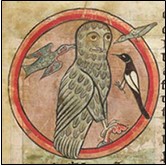
We are lucky to have several different species of owl living in the UK today, so thankfully our Tudor ancestors were not successful in eliminating these beautiful birds. The cry of the owl was seen as a sign of impending disaster, a warning of death and bad luck. It was also believed that the souls of murdered victims took the form of owls, and their piercing cry was their demand for justice. As a result of their link with supernatural forces, they could not be allowed to torment the human population, and 1 penny was seen as a just reward for hunting them.
This blog only mentions a few of the mammals and birds targeted under the Tudor Vermin Laws; the list also included rats, jays, stoats, weasels, polecats, magpies, bullfinches, hares and more! The implementation of the Tudor Vermin Laws in the middle of the sixteenth century not only introduced financial incentives for killing vermin, but also gave official sanction, moral emphasis, and structure to the war against many wild creatures. Thankfully, the Tudors failed to remove these beautiful birds and mammals from the UK, and now we endeavour to protect rather than hunt our local wildlife.
Recent Comments