
The Little Owl (Athene noctua)
By Kirstie Bingham
Throughout the year, we regularly host Birds of Prey days with J.R.C.S Falconry, it was at one of these events that I first saw a Little Owl up close. I remember remarking how beautiful they were and the expert replied “yes, but they have little man syndrome.” These stern owls may be diminutive in size, but they are full of character. The Little Owl was proudly perched and standing tall on his stand, looking around inquisitively with piercing yellow eyes at what was going on around him. To be fair, there was a Golden Eagle at the other end of the room, so you can’t judge the wee guy for trying to make himself stand out. I am vertically challenged too (the polite way of saying short), so I feel a certain infinity with these birds. A hulking Hooded Vulture, a striking American Kestrel, and a majestic Eagle Owl may have accompanied him, but the star of the show for me, was definitely the moody Little Owl.
The Little Owl has neither vibrancy in colour nor size going for it. They have flat-topped heads, a plump, compact body and a short tail. The mottled brown and white plumage is perfect for blending in with their natural habitat, so they are masters of camouflage if they don’t want to be seen. They have bright yellow eyes and white eyebrows, which gives them their perpetually stern and frowning expression. They are the smallest species of owl in Britain, so constantly being looked down upon, could make anyone a tad grumpy.

“You talking to me?!”
You can find the Little Owl in the temperate and warmer parts of Europe, Asia, and North Africa. They were first introduced into Britain at the end of the nineteenth century by two landowners, Col. E.G.B. Meade-Waldo from Kent in 1874, and the 4th Lord Lilford in Northamptonshire from 1889. Lord Lilford had collected the birds he released in England from Holland, liberating a number of birds over several years. He was so successful in introducing the little birds to England that they were known as Lilford’s owl for a while. They are most common in central, southern and south-eastern England and the Welsh borders, especially in lowland farmland with hedges and copses, parkland and orchards. Though most active between dawn and dusk, they can often be seen about during the day, often in full daylight, though they seldom hunt in the day. During the day you might find them perching on a tree branch, telegraph pole or rock. If you see them bobbing their head, it means something has alarmed them. They can be very vocal and have a wide repertoire of between 22 to 40 different calls. Typical calls include a plaintive ‘kew’ ‘kew’ and a loud ‘wherrow’, also listen out for their strange mewing call or the male’s ‘hoo-eet’ song on summer evenings.
Little Owls are a cavity-nesting species, with nests recorded in tree holes, rock crags, haystacks, buildings and even in rabbit holes. They will also nest in nest boxes, so you can help your neighbourhood owl with setting up a home for them. Owls are faithful to their nest sites and will return year after year, provided both of the pair survive. Little Owls will establish their territories in the late winter and early spring, with some territories covering nearly 40 hectares (or 98 acres) just prior to the breeding season. The territories shrink to as little as 2 hectares (or 5 acres) when the pair are providing for their young, to shorten the time between feedings and protect the chicks. Between three and five white eggs are laid towards the end of April, with incubation lasting approximately a month. The young chicks will fledge at 5-6 weeks of age, but they often leave the nest some days earlier, perching on nearby branches. Most young birds disperse in the autumn, usually settling within 20km of their birthplace. Little Owls are ready to breed when they are one year of age and once they have found a partner, the pair maintain a life-long bond.
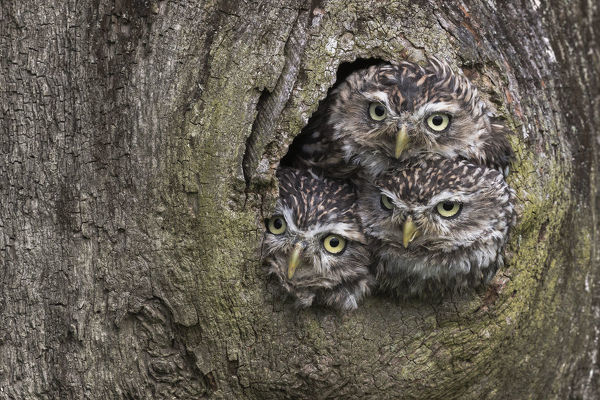
Room for one more?
Little Owls have retinal cells more similar to diurnal birds and have the poorest visual acuity compared to other birds of prey. They can see yellow, green, blue, and (to a lesser extent) red. Little Owls can also distinguish between different shades of grey, increasing the ability to see at night. Little owls can also hear sound frequencies of 3 to 4 kilocycles per second (kc/s), which allows them to locate prey extremely accurately. The Little Owl has a varied diet with insects (e.g. grasshoppers, crickets and invertebrates such as beetles and earthworms) and small mammals (e.g. mice, voles, shrews) forming the bulk of their food, but they will also prey on small birds, amphibians and reptiles. The owl will perch in an elevated position ready to swoop down on any small creature it notices. Once the little owl spots its prey, it swoops, grabbing its meal in its claws or beak. They will also hunt on foot and run to capture their prey. If they build up a surplus of food, they will store it in holes or other hiding places for leaner times.

“Wait up! I only have little legs.”
Statistics suggest that Little Owls may reach an age of about 16 years old; however, the average is around 4 years old. Unfortunately, evidence has shown that Little Owl numbers are declining in the UK. Between 1995 and 2010, Little Owls declined by an estimated 40%, particularly in the western part of their range. They are absent from Ireland, and have disappeared from almost all of Scotland. They are now considered scarce in Wales and the western counties of Cheshire, Devon and Cornwall. The reasons for the recent decline are unknown, but the two most significant influences on nesting success appear to be food availability and prevailing weather conditions, particularly cold, wet weather. We can’t do anything about the weather and climate change is something that we are all going to have to tackle together; but we can help the remaining 6,000 pairs in Britain by providing nesting sites and food, especially during harsh winters.
I am not the only one who appreciates the Little Owl. In Greek mythology, the Little Owl was the bird sacred to Goddess Athena, the Goddess of Wisdom or her Roman counterpart the Goddess Minerva. A Little Owl with an olive branch appears on a Greek tetradrachm coin from 500 BC and on a 5th-century B.C. bronze statue of Athena, she is holding the bird in her hand. Even today, traces of the Little Owl can be seen on the modern Greek one-euro coin.
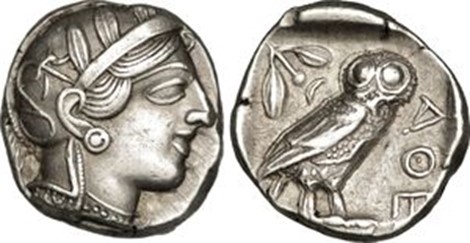
Athenian tetradrachm coin representing the goddess Athena, with a little owl and an olive branch on the reverse.
The Little Owl is vocal and territorial, yet somehow endearing. Their numbers are on the decline and I truly hope that we can help protect them, since the world would be worse off without these little characters in it. We have a beautiful Little Owl in our Natural History collection in the museum, so pop in for a visit to see him and many more mammals and birds from around the UK.
Saw a little owl three nights ago on my wall.
It stood still for a little under an hour.
It was Father’s Day( 15/06/2025) Was wondering the significance of his presence. Bight yellow circle around the eye…
Felt at ease after reading about your article.