

Lucile Bell
By Angela Dunsby
At the John Moore Museum we have an enthusiastic respect for the man we will never meet and yet know so much about, but it is worth remembering that behind the museum’s namesake stands a woman who was instrumental in the life of John Moore and his works.
Lucile Douglas Stephens was born on the 4th June 1916, in Melbourne Australia. She was the third child of Henry Douglas Stephens, a distinguished Australian paediatrician. Lucile was academically gifted and became the head girl of St Catherine’s School and later went to university to read English literature. At 17 years old, she had gone aboard a German warship which had been making a goodwill visit to Australia and this is where she met a handsome crew member, Gerhard Stamer, (it is unclear what the relationship was between Lucile and Gerhard, although he does appear later in her story). She gave up her studies in 1937 which displeased her father, he was equally dismayed when she decided to accompany a friend to Europe.
After 6 weeks at sea, Lucile and her friend disembarked at Genoa, and travelled Europe extensively during which time she developed a passion for the European culture. Eventually, her travels brought her to London. In order to replenish her resources, she became a secretary before heading off for the continent again. During the summer of 1939 she stayed with the family of Gerhard Stamer, who lived near Munich, and toured extensively the Rhine and Moselle areas. It was during this trip she met a British consul on August 26th, who advised her to leave Germany immediately as he knew of the impending war. Lucile immediately began her journey through a chaotic France before arriving in Dover on the eve of the war.

Lucile
Unfortunately, it was too late for Lucile to return to Australia, so she embraced the war effort. Lucile did everything she could to help, such as peeling spuds in a fire service canteen to being a stretcher car driver who served throughout the blitz in London’s East End. In 1943, she joined the Wrens.
In February 1944, Lucile was recovering from the broken engagement to her fiancé, Major Jimmy Hutton DSO, MC, (I was unable to uncover any details about Major Hutton, where the pair met or whether they stayed in touch). After waiting 3 years for his return, she discovered that the heavy fighting on the battlefields of North Africa and Italy, had greatly affected him and he could not commit to their relationship. It was during this emotional time that she first encountered John Moore.
Lucile was invited to the wedding of her friend Margot, but was reluctant to attend following her recent heartache. At the wedding Margot did a little matchmaking and introduced Lucile to John Moore, a 37-year-old bachelor and Lieutenant Commander in the Fleet Air Arm. John’s first words to Lucile were “I’m Johnnie, you must be Lucile, I recognise those gorgeous eyes from Margot’s description!” John was very handsome and charming and Lucile offered him a room for the night. John was asked to escort Lucile across London to the Savoy Chapel. She waited for him under the clock at Waterloo Station but had no intention of forming a new relationship, John on the other hand had already decided that Lucile was the woman he would marry. Lucile asked John not to contact her again, but after 2 days he knew that he could not honour her request, she was too beautiful and intelligent, so he wrote her a letter. Lucile agreed to meet John again as he continued his pursuit of her. John wrote a letter to his mother, Ina Moore. “She has green eyes and brown hair he wrote.” After many failed romantic dalliances, Ina, was dismayed at yet another romance and protested the new relationship. Despite her protestations and Lucile’s fears, the pair were married after only 6 weeks. The wedding took place on the 1st of April 1944 at Caxton Hall with witnesses Eric Linklater and Compton Mackenzie.
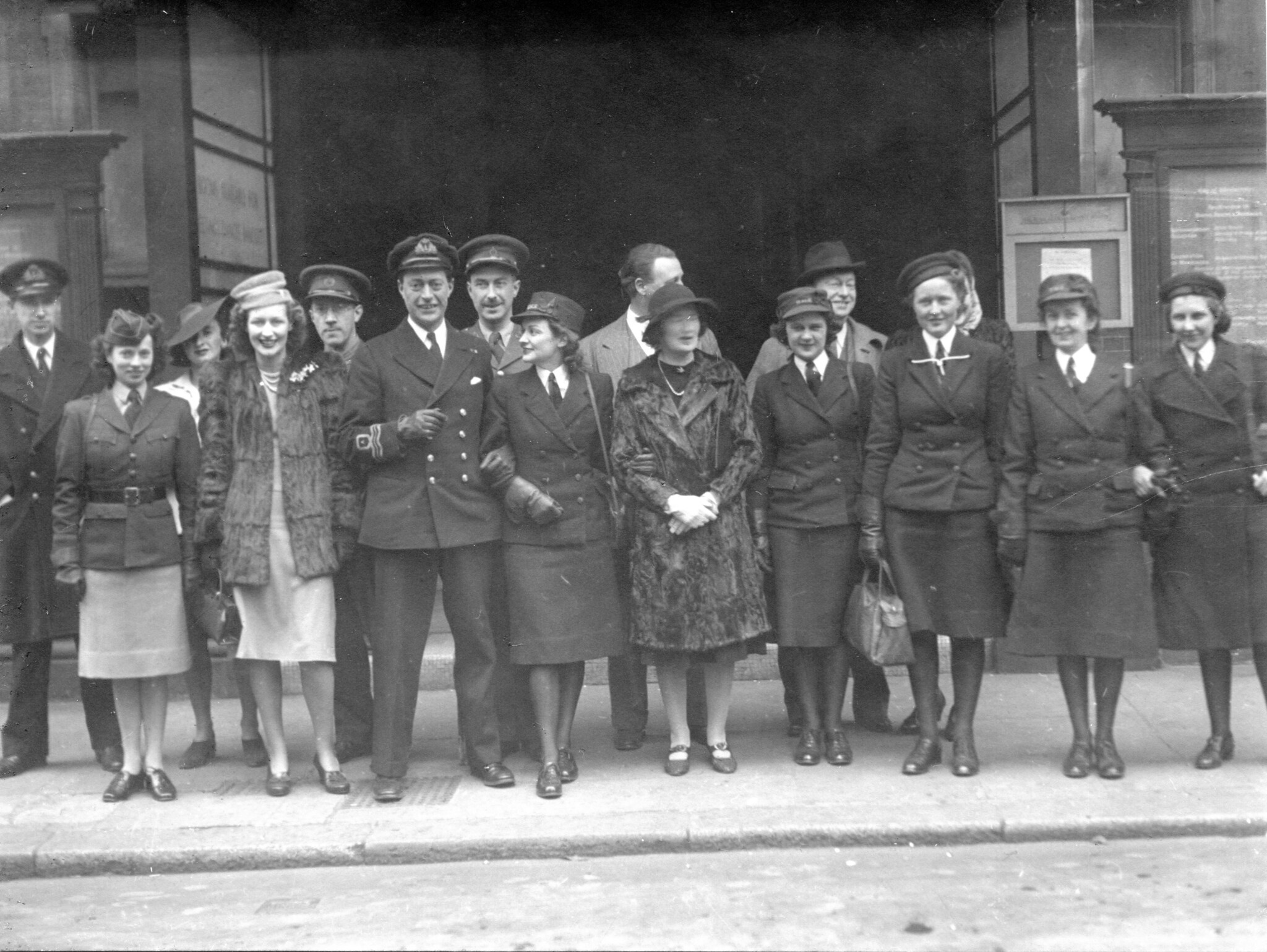
John and Lucile’s Wedding Day
Lucile returned to her duties as a staff nurse at a training establishment while John continued his role in the planning of the invasion, unaware that Lucile was becoming increasingly ill, as he had seen little of her during his preparations for war. Lucile became depressed and applied to terminate her Wren service. Whilst waiting for a reply, her condition deteriorated, and she went to a Royal Navy hospital with an unidentified illness, which led to her being transferred to Westminster Hospital in London. She was found to have a sort of granular lung disease. Lucile was taken to Tewkesbury to be cared for by John’s mother while a local doctor contacted Lucile’s family in Australia to see if there were any previous medical clues to her condition. It turned out that during infancy, she had developed a lung condition which could now have recurred in the more serious form of Sarcoidosis. As she was not expected to live, John took 3 months unpaid compassionate leave to stay with her, his mother was exceedingly kind and took great care of her. During her illness, Lucile encouraged John to resume his writing as they had no money. She proved a major influence on his work and brought discipline to his craft. She encouraged him to sit at his desk and call his writing “a job.” This encouragement resulted in his biggest success “A Portrait of Elmbury.” Once recovered from her illness, Lucile supported John in his roles as an author, broadcaster, naturalist and newspaper columnist. Without the support of his wife, one must wonder whether his career would have been as successful. Lucile opened a bookshop in Tewkesbury to supplement their income as John was trying to live the life of a country gentleman and had spent all their money without having saved any capital. Lucile’s bookshop closed after 4 years. After authoring more books, their circumstances improved and Lucile was able to visit her family in 1957 for the first time since 1938, they also moved to Kemerton, one of the Bredon Hill Villages.
Gerhard Stamer unexpectedly reappeared in Lucile’s life, John did not take kindly to this. Stamer sent a postcard to Lucile from a prisoner of war camp in South Wales where he had spent 7 years. He had been shipwrecked in one of the first naval actions of the war and identified Lucile from publicity material connected with the publication of John’s book “Portrait of Elmbury”. Eventually John allowed correspondence between them, and after his death in 1967, Lucile was able to visit Stamer and his wife in Germany.
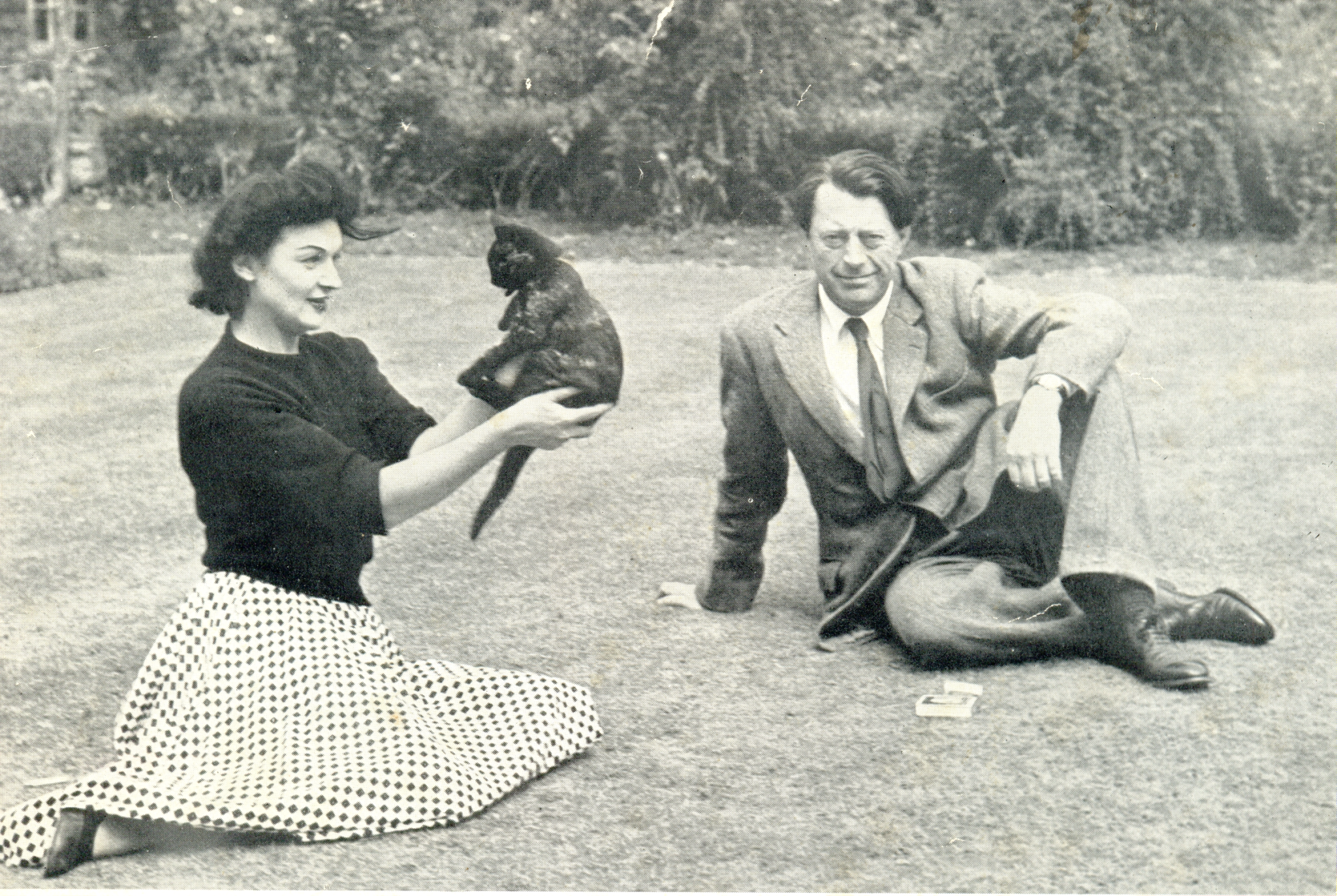
Lucile and John in their garden
Lucile loved nature and literature as much as her husband, and played an important part in the success of the Cheltenham Literary Festival where she was a fabulous host. With her vivacious charms she won over poet laureates Cecil Day Lewis and John Betjeman, also authors H E Bates, Compton Mackenzie, Laurie Lee and C S Forester. Such was Lucile’s charm that Betjeman wrote her a thank you letter saying, “Those half moon eyes and springy hair haunt me.”
John was diagnosed with cancer of the oesophagus and was admitted to hospital in Bristol where he died in 1967. Lucile was unable to think about the future and went into mental turmoil.
Lucile had been left with little money and life was difficult for several years, she received little more than £10,000 and was forced to leave her home in Kemerton. She tried different ventures, designing jewellery, founding the Abbey Tea Rooms, secretarial work and also hotel management.
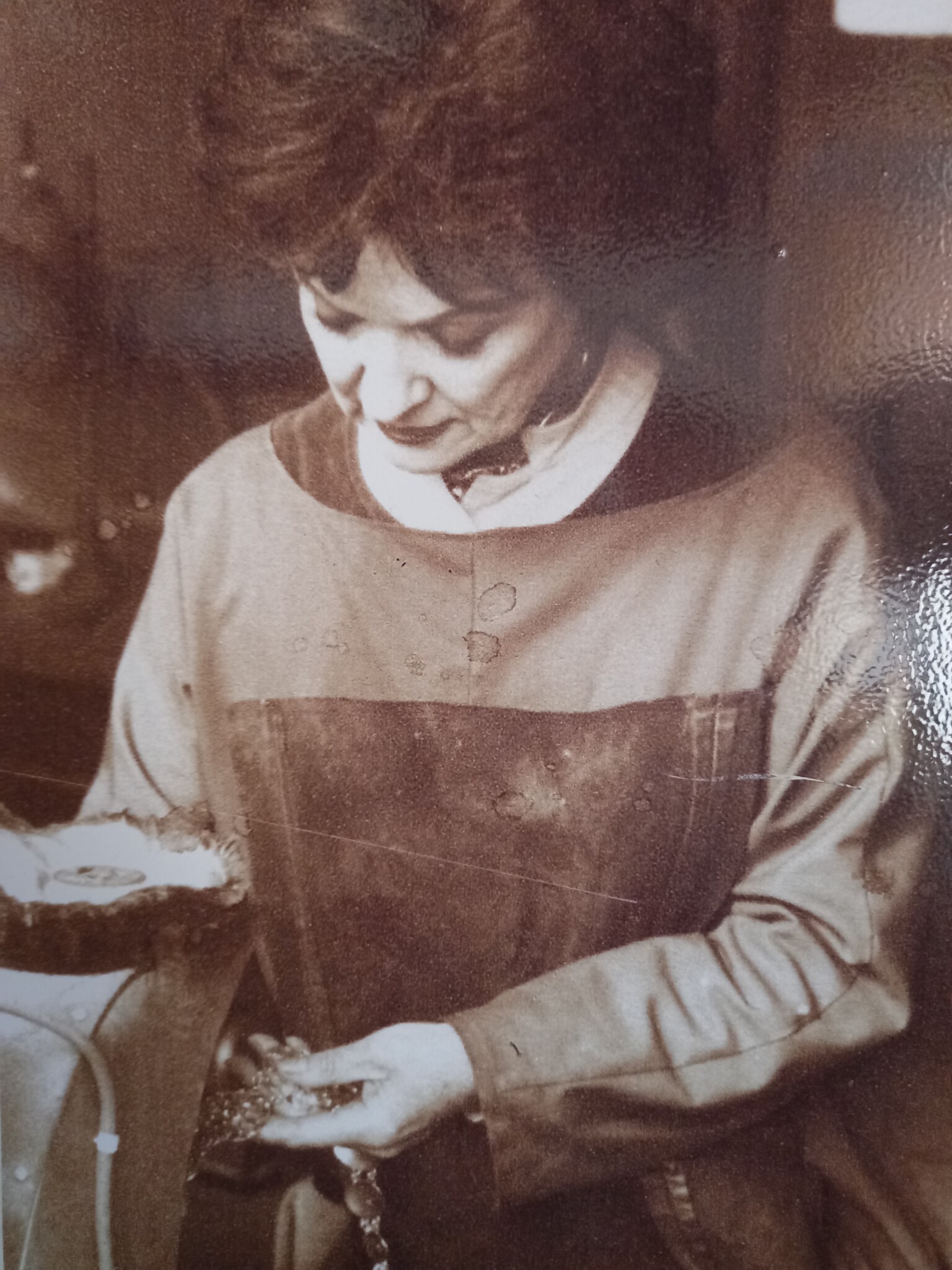
Lucile designing her silver jewellery
Eventually, she moved into a smaller house in Overbury where she met her next husband, the retired headmaster of Cheltenham Grammar School and noted academic, Arthur Bell. Lucile and Arthur lived at Mythe Crest for many years. After a 25-year marriage she was widowed for the second time when Arthur died in 1995. After his death, Lucile moved to the smaller cottage in the centre of Tewkesbury, in Turner’s Court behind Tewkesbury’s High Street.
Lucile was always loyal to John Moore and endeavoured to keep his memory alive by re-publishing some of his books. She became a patron of the Cheltenham Literary Festival and was instrumental in the formation of the John Moore Museum.
Lucile devoted herself to keeping John’s work alive; she also supported Tewkesbury Historical Society for 12 years. Lucile died peacefully on the 6th of September 2003 following a short illness, and is buried with her first husband in the grounds of Tewkesbury Abbey.
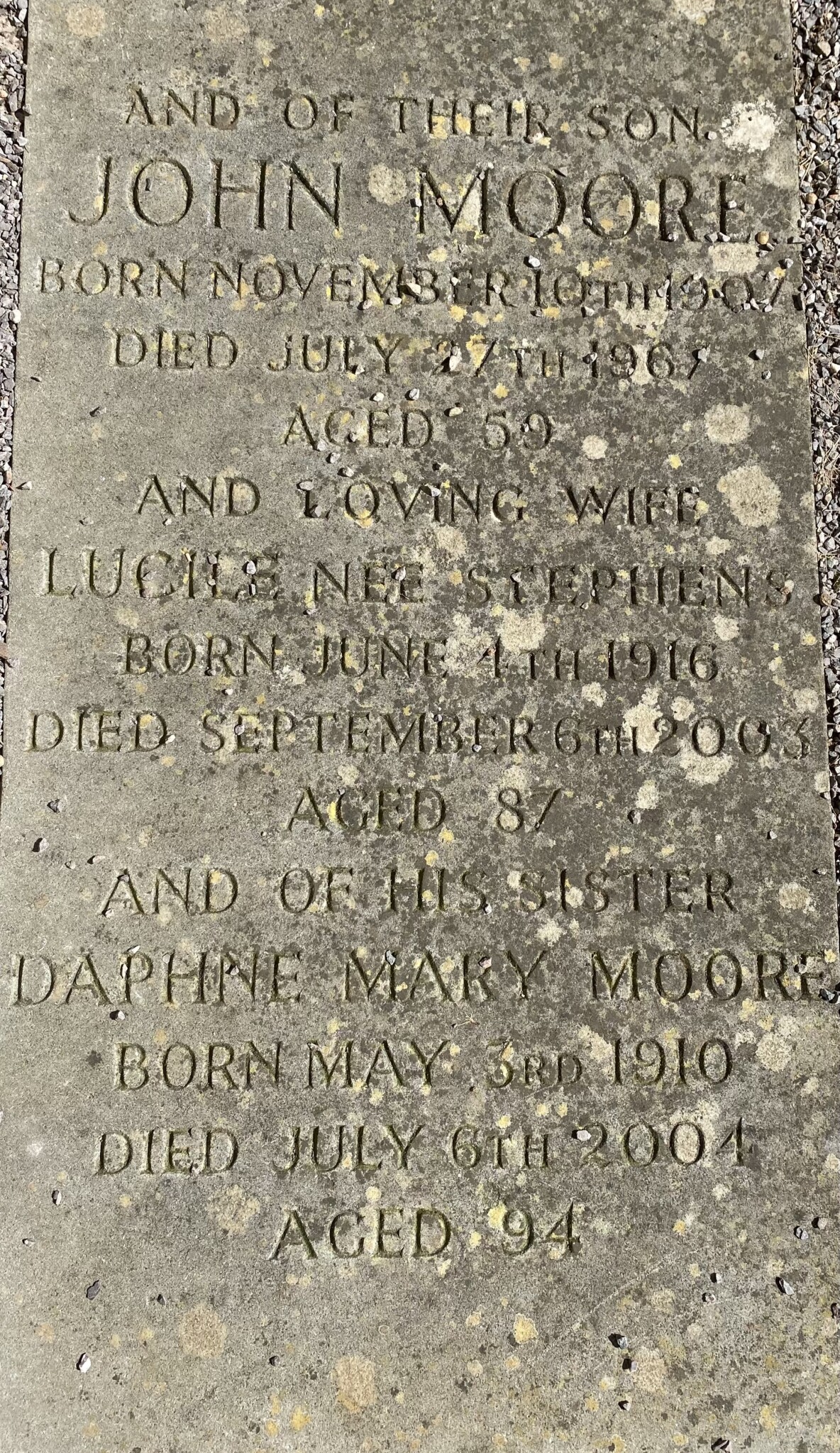
Grave marker in Tewkesbury Abbey
Recent Comments