
Long tailed tit (Aegithalos caudatus)
By Chris Thorley
Description
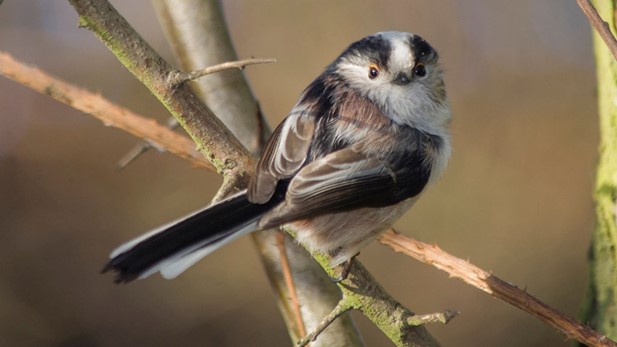
The long tailed tit is one of the UK’s smallest (and most adorable) birds. They are only 14cm long (a lot of that length is their long tail which is longer than their body) have a 16-19cm wingspan and weigh a mere 7-10 grams (lighter than a £1 coin!) Their fluffy round bodies and long tails gives them a slightly comical appearance (they are sometimes described as flying lollipops or flying teaspoons.) The long tail is particularly visible in its undulating flight.
Habitat
They are most common in woodlands and hedgerows but can be found anywhere with suitable bushes (including gardens). Oak, ash and sycamore trees are favourites of the long-tailed tit. They are social birds and are often seen in noisy, excitable groups of 20 or more birds. They are found all across the UK. Since they don’t migrate they can be seen all year round.
Behaviour
They are constantly calling to each other and their calls get louder and faster if one is separated from the group. This high pitched contact call is more likely to be heard than their twittering, trilling song. Their social behaviour helps them on cold nights as they huddle up together for warmth.

Huddling together
Taxonomy
Despite the name tit they are not that closely related to great, blue or coal tits and form a separate group with 12 other species (none of which are found in the UK) of long-tailed tits or bushtits. In other areas of the long-tailed tits range (throughout Europe and parts of Asia) they have different plumage variations to the birds we get in the UK.
Diet
Their diet mainly consists of small invertebrates, particularly the eggs of butterflies and moths. In winter they will eat seeds when invertebrates are largely absent. They are most easily attracted to feeders with peanuts.
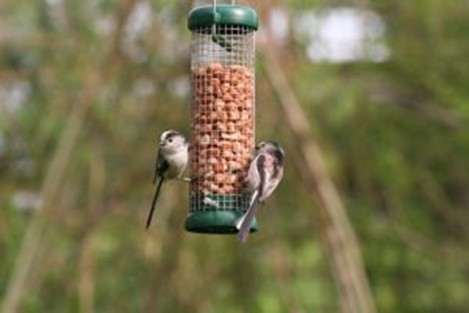
A Feast in the Garden
Nesting
One of the most interesting things about the long-tailed tit is their nest building. They build a nest from feathers, moss, lichen and spider egg cocoons (over 6,000 individual pieces are used in the construction.) The flexible and intricate cocoon like nest is similar in shape to a bottle. It has a hole at the top for the birds to enter. Moss and cobwebs are stitched together and lichens provide camouflage. Inside, feathers (up to 1500) are used as insulation. A single clutch of 6-8 eggs (although it can be less, there can be as many as 14) is laid in spring which are incubated for 15-18 days. If a pairs nest fails (long-tailed tits have the highest nest failure rate of any garden birds) they will split and help others with their nests. Around half of nests have one or more helper. This altruistic behaviour helps boost the survival rates of the helped nests as the helpers are able to assist with defending the nest. The helpers also help feed the chicks once they hatch. The nest is designed to be stretchy so it can accommodate the growing chicks. After 14-18 days from hatching the chicks are ready to leave the nest, although they will stay in the same flock as their parents.
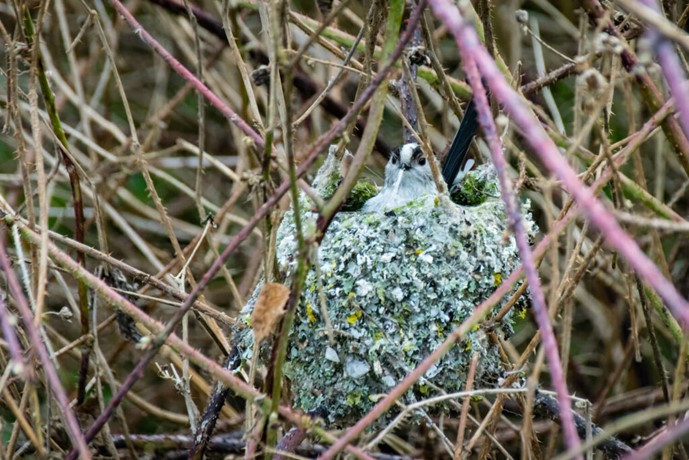
Nesting
Predators and threats
That extra defence is useful as nests are vulnerable to corvids and weasels. Sparrowhawks are a predator of adult birds. Due to their small size, cold weather is a major killer of long-tailed tits. They are not considered to be under threat of extinction in the UK or globally. Further destruction of the hedges and deciduous woodlands they generally live in would be likely to cause a population drop, however, currently numbers appear to be increasing.
Lifespan
Typically long-tailed tits live for 2 years with breeding beginning after the first year. However they can live for up to almost 9 years.
Folk names
The long-tailed tit has a large number of UK folk names. A Gloucestershire folk name for them is mumruffins (John Moore refers to mumruffins in his book “You English Words”.) The long-tailed tit has many folk names (often with obscure origin) such as bottle Tom, poke pudding and bumbarrel.
“ ‘Mumruffin’ is particularly endearing example of this; it is the nickname we give to the long-tailed tit, and the Colonel, of course, when he found those purse-shaped beautifully tailored nests in the sloe-bushes, always spoke of ‘the clever little mumruffin’ that made them. It sounded like a word invented by children.” (Come rain, Come shine)
What can we do to help?
Dense bushes and shrubs can provide long-tailed tits suitable habitats for nesting. Due to their intricate nest building, they will not use nest boxes. Avoiding using pesticides in the garden will help create the insect population they need to survive. Fat balls and suet balls provided during winter on the bird feeder can help long-tailed tits survive a cold winter.

Long tailed tits in winter
is there a collective noun for long tailed tits
They have a few collective nouns attached to them, including a volery, a zephyr or a snuggle.