

“How far women may speake…?”
By Kirstie Bingham
Thankfully, we live in a society today where this question, “How far women may speake & how fare not” is no longer socially acceptable. However, that was not the case back in the seventeenth century, when the Tewkesbury Baptists raised this issue in 1656 during one of their meetings. Society and religion were strongly intertwined, so the Baptists followed the examples set out in the Bible, such as Corinthians 14.34.35. and Timothy 2.11.12. As a result of this debate, the Baptists listed when it was appropriate for a woman to speak, and also when she should not. The fact that the Bible lacks any female perspective or authorship only strengthens the male case unfortunately.
The rules for when not to speak are listed as follows:
1. “They may not soe speake as that their speaking shall not shew a not acknowledgeing of the inferion of their sex & soe bee a userping authority over the man.”
Essentially, she cannot be too clever, because that would mean she is trying to overstep her bounds as a member of the inferior sex, who must be submissive to the men in her life.
2. “A woman may not publikely teach in the Church.”
A woman’s understanding of the Bible could not be as knowledgeable as a man’s, so she could lead others astray because of her ignorance.
3. “Shee may not speake in the Church by way of pasing sentence upon doctrines or cases.”
A woman would have strayed into the male domain of authority if she dared to pass sentence on a man.
4. “Shee may not stande up as a ruler in ye Church & soe speake uppon that accounte.”
A man must lead the congregation, and the Baptists had no female pastors or members of the Midlands Association for centuries.
However, the Baptists do stipulate that there were a few occasions when a woman was permitted to speak.
1. “If shee desire to make profession of her faith to the Church to expresse her desire of Baptisme & communion.”
A woman’s devotion to her faith was seen as a virtue.
2. “If shee bee a wittnesse confirming ye Church admonition.”
On this account, she is only affirming the Church’s warning, not deciding on the nature of it.
3. “If shee be sente from another Church as a messinger she may deliver her message.”
The woman is merely a mouthpiece for the authoritative man at another Church, her opinion or knowledge is not relevant.
4. “If shee have neede of ye churches assistance in any thing shee may impart her just desire & lay open her case to them.”
The Baptists offered financial and social assistance to members of the congregation, both male and female.
5. “If a woman have sinned & cast out of ye Church & god hath given her repentance undoutedly shee may manifest it.
She may speak in repentance and ask humbly for forgiveness from God and the other members of the congregation.
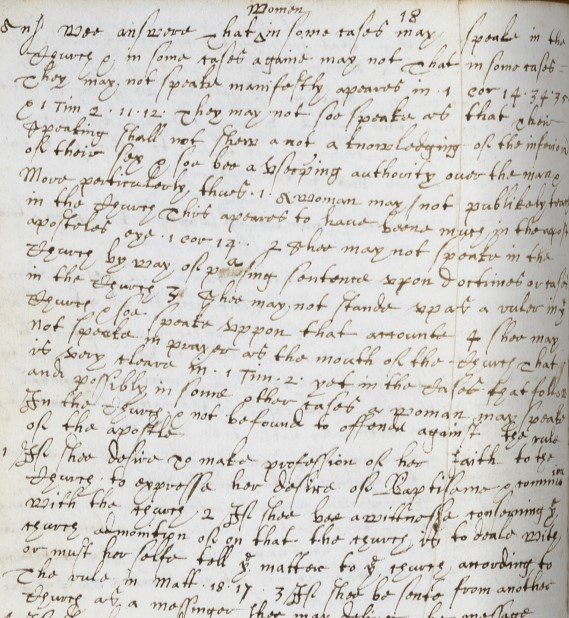
A page of the Baptist Minute Book revealing the topic and answers to the question: “How far women may speake…?”
When you read the list, it is fairly easy to divide them. On no account may a woman speak her own mind and or make decisions on her own. However, she can speak when it is to reinforce her faith or pass on the messages of a man. The congregation at the time was predominantly female. We know in 1663 there were 128 members, 84 (65%) members of the congregation were female; 44 (35%) were male. This shows just how socially acceptable these rules were, since even in a female dominant group, it was seen as the norm to follow, and not question the men. If the question was raised today, I am fairly positive the 44 male members would have a verbal fight on their hands to put these speaking rules in place. However, this is a modern perspective, which has only begun to develop within living memory. For thousands of years, the authority of men over women has been the norm, not just in Britain, but also within most countries and cultures. There is a fantastic quote by Matsudaira Sadanobu, a chief minister and regent in Japan in the nineteenth century, who declared “when women are learned and clever in their speech, it is a sign that civil disturbance is not far off.” It is true that women were once again marginalised, but I like how he did not underestimate the impact that an educated woman could make.
After I saw these extracts in the Minute Book, I decided to create a talk on women’s history in the sixteenth and seventeenth centuries. When I was undergoing research for this talk, I had a meeting with an older gentleman for work, and this project was mentioned. His response to a talk on women’s history was “why do you want to waste your time doing that?” I remember sitting there thinking, “he did not just say that!” My parents had indoctrinated me well as a child to be polite to my elders, so a biting response did not seem appropriate in a work environment. However, years later, this has stayed with me, we are in the twenty-first century yet this inequality on gender still exists. Let’s not allow another group of people, irrespective of gender, race, religion, sexual orientation etc. to be side-lined onto history’s silent benches because they are not in a position of power or with the majority.
Recent Comments