

Historical Dress Up! Live Interpretation in the Heritage Sector
By Kirstie Bingham
One of the perks of working in the heritage sector is the opportunity to dive into the costume cupboard and transform into a historical figure. In my career, I have taken on the persona of several different characters, from a Georgian Countess to the Housemaid, a Victorian Marchioness to the Cook and now a Medieval Merchant’s Wife. At Christmastime, I have even been transformed into an Elf (glamourous I know), welcoming families on their way to meet Santa! However, you do experience a heritage site completely differently when you are in historical costume. You may have walked the historical corridors hundreds of times already, but somehow it feels different, you are different, because the costume makes you walk and move slightly differently. At first, I was a little apprehensive at the thought of dressing up; back in school, drama class was never a forte of mine, but this feeling soon disappeared once I had the costume on.
I truly believe that live interpretation in heritage sites can enhance a visit for the better. When visitors see a guide dressed in costume, they can more easily visualise how a historical property was used and lived in. I unintentionally gave one lady a fright as she saw me standing still in a busy room; thankfully a wave and ‘hello, I am quite real’ helped to dispel her shock that I wasn’t in fact a ghost. The costumes have a way of breaking the ice, because curiosity can overcome shyness. As a consequence of this, the questions I was most frequently asked were: ‘What is the dress like to wear?’ and ‘Is that comfortable?’ I thought I would try to briefly explain my experiences dressed in historical costume to you. So join me on a quick whirlwind tour of ladies clothes from the Medieval period to the Victorian age.
Merchant’s wife or daughter
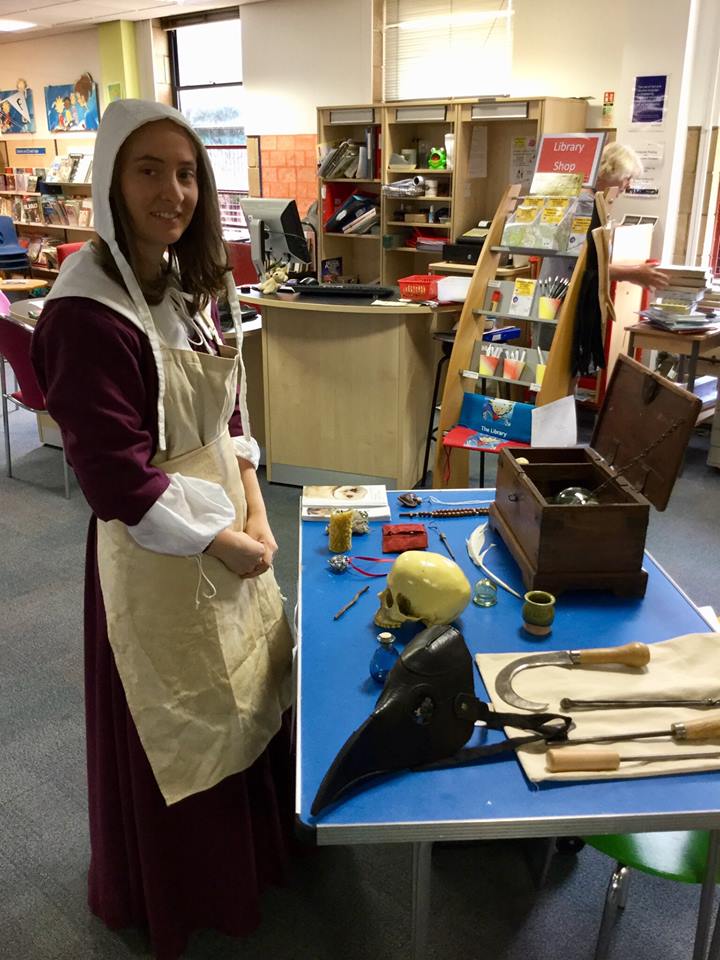
Outreach event at Tewkesbury Library
The Merchant’s House in Tewkesbury has been restored to how it would have looked in the 1500s, so this time I was transported back to the Tudor era. The Merchant’s House would have been a home and a place of business for a merchant and his family, so he was financially comfortable but not wealthy. The ladies in the house would have worn heavy wool dresses in a block colour with lacing at the front and a white linen shift beneath. Overall, this dress is comfortable to wear, since you don’t have any restrictive corsets or hoops. It is lovely to wear in winter, since the thick wool is cozy and warm, but unfortunately, it then becomes hell to wear in summertime. I can understand why the wealthy would change their linen shifts multiple times a day. Furthermore, it is easy to trip in the long dresses, especially when climbing up stairs with narrow treads. Another hazard is the open hearth in the Merchant’s House, and I can imagine that many women’s dresses could have caught on fire if they weren’t careful. One of our sites, the Old Baptist Chapel, is across the street from the other buildings. As a result of this, you have to walk along the pavement to reach the alleyway, all the while people in passing cars are giving you odd looks saying “what on earth is she wearing?” Thankfully, Tewkesbury is a town where people in historical costume is not a new occurrence, so you can just smile and wave. Whether I am leading an outreach session (as seen in the photograph) or delivering a talk, I can always see that the audience appreciates the fact that I am in costume, so I will continue to wear them in the future.
Georgian Countess

Glamorous Georgians….
Before I joined the team at the John Moore Museum, I previously worked at Culzean Castle in Scotland. On a few occasions, I became a Georgian Countess, which in my opinion was the trickiest costume to wear. The main feature of the beautiful crimson dress that made it so difficult was the panniers or side hoops. Panniers were part of a wealthy lady’s undergarments worn in the 17th and 18th centuries to extend the width of the skirts at the side, while leaving the front and back of the dress relatively flat. This provided a panel where woven patterns, elaborate decorations and rich embroidery could be displayed. By widening out the skirt, you could fully appreciate the beauty of the dress’s fabric; however, it did make moving around incredibly awkward. I had to mentally adjust my body awareness to include an additional metre width, especially when navigating through doorways, which suddenly had to be done by going through sideways. I also quickly realised that sitting down was going to be a problem, especially when I nearly misjudged the width of my skirt and the location of the chair, thankfully no ungraceful falls occurred. On top of having some extremely wide hips, the dress came with a corset too. I needed help with the lacing of the corset, and it took between 10 to 15 minutes just to cinch me up. I do have to say that the corset does wonders for your posture though, since any slouching is uncomfortable. A few things became slightly problematic when wearing the dress, such as bending to pick something up, trying to stay cool in the heavy layers and giving yourself plenty of time to get anywhere. The biggest obstacle to wearing a dress like this would have been visiting the bathroom, which I wasn’t brave enough to try, so a day with little fluids seemed the wisest course of action, especially since the modern toilet cubicles were too small for me to squeeze into. Finally, to top it all off, I even had a blonde wig on, which was all the rage in Georgian times, but truthfully it was uncomfortable to have such a weight balanced on my head for hours. Although it certainly helped me come to the conclusion that blonde hair really doesn’t suit me at all.
Victorian Life
One day I would be a Victorian Marchioness who could leisurely take a turn about the room, and the following day I was demoted to the kitchens, scuttling along the corridors with my mop cap flapping around my ears. You certainly notice the difference in lifestyle quite quickly!

Victorian Lady
My favourite character I was given to portray was a Victorian Marchioness. I was given a lovely full-length red dress with tartan trim, which included a hoop-underskirt, bustle and train. I soon discovered why the ladies needed a maid to help them dress in the mornings, since getting ready was time-consuming single-handedly. Nonetheless, the full impact of the dress made it worth all the effort. I think what surprised me was the effect the dress had on me; I straightened my back, shoulders slightly back and head held high. Young Victorian ladies would have been given deportment lessons from a governess, who would have instructed them on appropriate manners and a graceful gliding walk. Unfortunately, my dress did not come with a manual attached, so I had to quickly learn how to walk and manoeuvre in the dress by myself. I had to shorten my normal walking stride to fit within the confines of the underskirt; otherwise I would kick the hoop and step on the dress. The thought of the stairs was a little daunting in the beginning, as the possibility of falling was very real. However, I truly struggled when I had to step over the ropes to conduct a tour, as my train would always catch on the ropes. Obviously Victorian ladies wisely avoided obstacle courses at all costs. Despite the difficulties that came with wearing the dress, it was honestly a lot of fun and a part of me misses wearing it, because it does make you feel special.
I didn’t spend all my time waltzing around the grand drawing rooms, I also descended into the servant’s quarters and transformed into a Victorian Cook. This costume was a thick, high-necked cotton black dress with white trim at the collar and cuffs. The dress was accompanied with a white apron and mop cap. Although this costume was far from the stylish spectrum, it did have some positive points. In comparison to the lady’s gown, the cook’s outfit was more practical, so it gave me a greater range of movement. This proved to be necessary, since I was baking a range of popular Victorian sweets including shortbread and parliament cakes. The delicious scent of baked goods would entice visitors into the kitchen and then they would see me in costume. The sight of the historical kitchen back in action always proved popular, with visitors watching and asking me questions on what I was doing. On account of the dress’s heavy material, you quickly become rosy-cheeked as you bustle about and toil in the heat of the kitchen, so I can certainly appreciate why the cook is always red-faced in period dramas. Unfortunately, I don’t have a picture of myself dressed as a Victorian servant, which is fitting really, since servants rarely had their photo taken.
Conclusion
Overall, I really enjoy dressing in historical costume and I would highly recommend heritage sites hosting living history days. It is a fantastic way to step into the shoes of our ancestors, and experience the ups-and-downs of their wardrobe. After spending a day in costume, I am always grateful to get back into my modern clothes, there is nothing like a good pair of jeans!
This ƅlog was… how do I say it? Relevant!! Finally I have found something which
helped me. Cheers!