
A taste of the sweet stuff…
By Kirstie Bingham
On the kitchen table in the Merchant’s House there sits an interesting object, a sweet smelling cone. Many visitors ask, “What is it?” A fair enough question as it is vastly different to what we have in our kitchens today; so many children cannot believe that the brown cone in front of them is the same as the fine white sugar they know and recognise. Sugar is everywhere, whether you like to pour a spoonful in your cup of coffee or love a chocolate bar, it gives our lives a delicious taste of sweetness. However, this commodity has had a long history tracing back thousands of years. Over the centuries, it has been a medicine, a spice, a symbol of royalty, and an instrument of disease and addiction. Sugar truly is a commodity that has had an evolving relationship with society, but there is no denying how influential this flavour has on the world. Poor honey, it no longer holds the Queen Bee spot for sweetness!
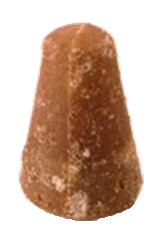
Sugar cone
Do you know from when we can trace the origins of sugar cane? Incredibly, it dates back to 8,000BC! Sugar is native to, and first cultivated in, New Guinea, where the inhabitants chewed on the reeds to taste the sweetness. As the centuries passed, this commodity and knowledge slowly began to spread across Southeast Asia, Southern China and India. Each region experimented with this new ingredient, and exciting dishes and treats started to be born. From 500BC, Indian manufacturers started making cooled sugar syrup, which was shaped in large flat bowls, it was called khanda, or candy as we call it today. Sugar wasn’t introduced to the West until the Greeks and Romans ventured into India. Nearchus, Alexander the Great’s General, writes of “a reed in India that brings forth honey without the help of bees, from which an intoxicating drink is made, though the plant bears no fruit.” It was deemed special enough that small amounts were brought back to the Mediterranean and traded to physicians for medical purposes. The Greek physician Dioscorides stated: “it is good dissolved in water for the intestines and stomach, and can be taken as a drink to relieve a painful bladder and kidneys.” Medically speaking the Ancient Greeks believed it was a useful ingredient to have, and this belief persisted for hundreds of years. The renowned Crusade Chronicler, William Tyre, noted that sugar is “a most precious product, very necessary for the use and health of mankind.” So at what point did sugar stop being used primarily for medicine?
Sugar continued to be grown, refined and experimented with in Asia and the Middle East, and gradually it began to be viewed in a new light, no longer as a medicine but as a food delicacy. Royalty and wealthy members of the nobility began to have lavish dinner parties, in which sugar sculptures made of marzipan performed a central role. The crusading knights acquired a taste for sugar in the varied and exotic dishes prevalent in the Middle East. Let’s be honest, the bland and lumpy pottage from home hardly compares, so many returned home with the ‘sweet salt’, sparking a demand across Europe’s wealthy for more of this product. The primary European trader was Venice, who dominated the sugar trade in the Mediterranean for decades. Despite a growth in trade, sugar remained a rare and expensive commodity to buy, so only the wealthy could afford it until the 1300s. By the end of the 15th century, sugar was being cultivated and refined on a large scale in Madeira. The Madeira sugar trade had approximately seventy ships, which transported the sugar to Antwerp, where it was further refined and then distributed to countries such as England. The Tudor Monarchs jumped on the sugar bandwagon, and Elizabeth I was renowned for having a sweet tooth.

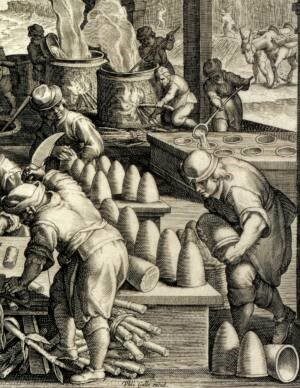
Sugar production in the 1600s
The whiter the sugar, the more elegant, desirable and expensive it was. By the 1600s, when the picture of sugar-making was printed, sugar was becoming a little more available. The cone-shaped moulds for the loaves had holes in the bottom so the dark treacly syrup from a mess of boiled sugar-cane could drain out. This didn’t leave perfectly white sugar in the mould, and ‘double-refining’ was used to produce a better grade of refined white sugar. Extra ingredients were used to encourage whitening and purification – from clay to bullocks’ blood (which really isn’t an appetising thought). Nevertheless, the sugar cones continued to be regularly shipped into England, and sugar was liberally sprinkled in tea and coffee but also on top of vegetables, fruits and puddings. As a consequence of this, a set of black and rotting teeth was an obvious sign that you were a rich sugar eater and therefore a marriageable prospect! It is at this point I usually like to discuss our ancestors’ dentistry practices (the tooth-worm exists!), but I’ll save you from the gory details.
The rising demand and lower prices of sugar meant a great reliance on slavery developed. During the 17th century alone, over half a million African slaves were shipped to Brazil and other New World colonies to work on sugar plantations. There were over two thousand sugar cane mills in Brazil alone. In the 18th century, sugar became an extremely popular commodity, representing 20% of all European imports; toward the end of the century, the British and French colonies in the West Indies produced 80% of the sugar. Public awareness began to grow in Britain on the conditions of slavery. In 1791, the British Parliament fails to pass the Slave Trade Abolition Bill, which leads to an abstention movement. Abolitionists boycott slave-grown sugar, and the movement increases the demand for slave-free sugar grown in India. It took another sixteen years before slavery was finally abolished in Britain in 1807; however, it remained a widespread practice throughout the rest of the world during the century. The production of sugar from other sources, such as beets, provided an alternative for consumers who opposed slavery.
Our love for sugar did not decrease over time, and soon the medical world began to grow concerned with the health implications of our sugar intake. In 1942, the American Medical Association’s Council on Food and Nutrition suggested that it “would be in the interest of the public health for all practical means to be taken to limit consumption of sugar in any form in which it fails to be combined with significant proportions of other foods of high nutritive quality.” The desire to limit sugar intake grew in intensity when studies proved that there was a correlation between sugar consumption and diabetes and other health problems, sparking a need for sugar substitutes. Gradually we have come to listen to the medical world and tried to limit our love for sugar, so we have reverted back to the ways of our ancestors. Ancient forms of sugar have made a comeback, most notably honey. Although we still love sugar and probably always will, it is nice to think that the natural ingredients appreciated by our ancestors is becoming popular again.

Busy bee
Why was the cone mould shape used.
Dear Leslie, thank you for your comment. Cones were easy to form and transport, although I am not sure why this shape instead of another. The cones varied in size, from a few inches tall to over a foot in height, the most expensive were the small cones, which were made from more refined white sugar. The cones were also referred to as loaves.
Best wishes.