
A Mark in Time
By Angela Dunsby
Throughout history, people have been afraid of the supernatural and witchcraft. The idea that a person could be cursed or attacked by an invisible enemy was terrifying for many people, and a solution was needed. And what better way to ensure safety from the dark side than putting marks in your home, using ritual objects or even magical symbols.
Most ritual protection marks or witches marks seen in buildings today date from the Medieval period through to the early 19th century, a time when superstitious beliefs were widespread (Witches marks should not be confused with witch marks which are the physical marks on skin that supposedly proved that a person was a witch and had fornicated with the devil). People also used charms and ritual concealments to protect themselves with items such as shoes, dolls, cats, and witch bottles all of which are often found concealed within buildings, (Witch bottles were found beneath hearth stones and often contained items such as pins, human hair and even urine). Although named witches marks or apotropaic marks, many of these protective symbols were in fact used for warding off evil, protecting the building and those who lived or worked within it. The evil that was being ‘turned away’ may have been demons, witches or even the evil eye. The word apotropaic comes from the Greek word apotrepein or warn off, apo – away and trepein -to turn.
Witches marks are found in all sorts of locations from barns, churches, cottages, and grand houses. They are also found on items of furniture and gravestones. It is usual to find markings near places such as doorways, windows and fireplaces, as these draughty areas are considered vulnerable entrance points for demons and are usually carved into stone, plaster and woodwork. There is a wide variety of protection marks ranging from pentagrams, mazes, crosses, diagonal lines, daisy wheels, gargoyles, grotesques, the green man and overlapping Vs, the Auseklis cross and consecration crosses. The Auseklis cross is a rare protection sign more commonly found in Eastern Europe although there is one to see in the stable block at Belton House in Lincolnshire. It is seen as a ‘sky’ symbol, associated with stars and night time. A powerful symbol, it was used for driving away evil spirits as it was believed that the stars brought light to banish the darkness.

Now to look more closely at some of the marks that can be found. The Daisy Wheel or Hexafoil is a compass-drawn circle usually with six petals within it and are common in Britain. The word Daisy comes from the old English ‘daeges eage’, meaning ‘days eye’. This signifies the opening of the daisy in the morning and closing up at night. The daisy blooms in summer when thunderstorms are prevalent and the daisy does not wilt or fade, and so is thought to provide protection against lightening. Occasionally, the daisy would have only three petals and was called a ‘trefoil’. The word trefoil comes from the Latin ‘trifolium’ which means three leaved plant. This could be in reference to the holy trinity and was often used in pagan and Christian symbolism. The holy trinity was also in mind with the ‘bulls eye’ mark, which contained three concentric circles to guard against the ever present, evil eye. Sometimes, groups of hexafoils are created as conjoined circles. It is seen as a solar symbol used to dispel darkness. The endless line was thought to confuse and trap evil spirits.

Next we have the Marian symbol. These symbols are associated with the Virgin Mary and often appear as an M, an AM represents Ava Maria and conjoined Vs may form a W which represents the Virgin of Virgins. The Marian symbol may also represent the vulva to signify the wonders of childbirth and creation, shunning evil with the vulva that gave birth to Christ. People worshipped Mary and this was an important part of pre-reformation religion, which did not die away post-reformation. These marks were used to beseech Mary for her supreme protection. They are often mistaken for carved initials and overlooked as the etchings of craftsmen of previous occupants.

Historic timber can often have taper burn marks; these are frequently overlooked as accidental candle burns or they have been painted over or destroyed by renovation work. Recent studies have shown that these taper marks are in fact, in places unlikely to have had a candle burning, such as roof timbers, on joists, under the floorboards and even on furniture. These tear-shaped burns were used specifically to protect the home from devastating fire, which was a real and definite threat throughout history, and particularly since many houses were constructed with wooden frames, and had rush matting on the floors. In this sense, the marks were literally used to fight fire with fire. It is worth noting, that many timbers were recycled or reused in other buildings, and the tear mark, which should point upwards, can often be overlooked if a beam has been reused, and the undiscovered mark, placed in a different position than one would expect. The mythological salamander has been used in its apotropaic capacity to protect a building from fire. Salamanders hibernate in decaying wood, and on discovering them whilst collecting firewood, many people thought them immune to the effects of fire and therefore could protect the home.
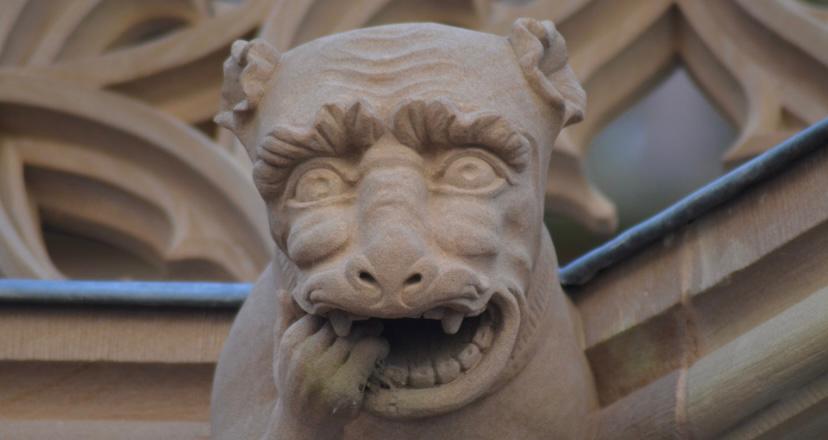
Gargoyles are found on the exterior of religious buildings, and are depicted with open orifices, with the idea that the bodily fluids would scare away evil spirits, (they also serve as a waterspout and carry rainwater away from the building). These delightful liquid spewers come in the form of figures, faces and mythological beasts. Dragon and beast tongues are often displayed and may represent a venomous snake in order to ward off evil. The grotesque, looks like the gargoyle, but does not have an open orifice and is more of a decorative carving that has no architectural purpose. The grotesque served to watch over whole towns acting not just as protectors but also as watchful eyes for any potential acts of blasphemy. They often portray mythical creatures which were a symbol of protection against evil for the building upon which they sat, and encouraged the viewer to reflect on the separation between themselves and the divine.
Since the time of the Egyptians, ships have had mounted figureheads on their vessels. These figureheads represented many things, from protection and vision (a sacred ibis), swiftness (a horse’s head), ferocity (a wolf or boar’s head), grace (a swan), mobility and aggression. Wooden bowls recovered from the Mary Rose were found to have markings, which not only denoted ownership but may have served as good luck symbols. Pentagram symbols were also found on bowls and may have been used to invoke good health. The excavation of the HMS Invincible, which sank in 1747, revealed a symbol on the inside of a chest’s lid. The ship was only 6 years old, so it must be presumed that the chest dates from the same period. It is thought that this witches mark would have been used to trap evil spirits inside the chest. It is also an indicator that these superstitious beliefs were continuing well into the 18th century.
The natural world could also be used as an apotropaic source. Trees such as yew, rowan, hawthorn and holly were all used as a way of protecting a home. Hazel and rowan twigs were often tied and hung above doors in order to ward off witches. In Medieval times, rue was hung in the windows to keep out evil entities. Rue was thought to invoke divine grace and even ward off witches. Eventually, the tradition evolved into the Catholic ritual of dipping the branches of rue into holy water and sprinkling it over the heads of followers to bestow blessings. In some rituals, dried rue is burned as incense for purification and protection. Carved turnips and swedes were used before the modern pumpkin, with the carved faces were created to scare away evil on all hallows eve, the night ‘when all may walk the earth.’
Apart from marks made into the structure of the home, there were also physical objects that could be used. Using a bull’s or lamb’s heart stuck with iron nails or pins and hung from red thread inside the chimney would deter evil from coming down the chimney. Putting bat dung over a doorway was thought to protect against disease and drive out demons. Coins in a purse were sometimes hidden around the home in order to trap evil by its own greed. Shoes were a popular deterrent and would be put near openings. Witches were believed to have been attracted by the scent of a human on a shoe, but if they put on the shoe, they would become trapped. In the 14th century, English saint, John Schorne, was said to have trapped the devil in a boot, and this could be the source of the belief.
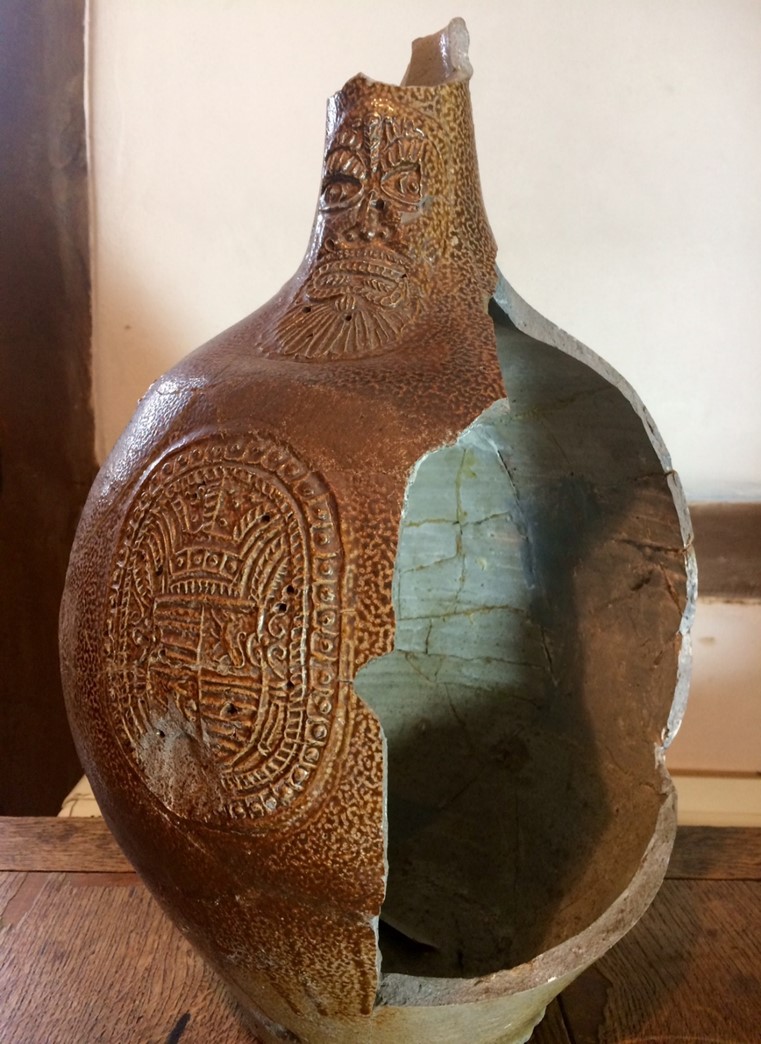
The German ‘Bellarmine Jug’ is a stoneware, salt glazed bottle that was used for trapping an evil spirit. The bellarmine jug dates to the 16th century, and is a type of stoneware bottle with the image of Cardinal Robert Bellarmine, a bitter opponent of the Dutch Reformed Church, stamped on its side. It would be sealed with nail clippings, clothing threads, rusty nails, pins, thorns, glass, bones, herbs, vinegar, oil, and predominantly urine. These ingredients were mixed together and placed in the chimney flue or under the hearth, floor or threshold. It was believed that the spirit would become trapped, and would suffer pain caused by all the sharp objects inside the jug. Alternatively, it could be thrown into the fire so that the evil entity would burn in the flames. The Merchant’s House has a selection of taper marks in the kitchen and below the smoke void. During the restoration in the late 1960’s, a large bellarmine jug was unearthed beneath the row of Medieval cottages. The Old Baptist Chapel has a mark below the stairs which could be an incomplete witches mark, or just an etching, presumably dating back to the time when the chapel was a dwelling, sometime between 1458 and 1623.
Although many marks can be found on historic buildings, it is important to remember that many builders and carpenters used markings to help with the construction of buildings and these markings are often mistaken for protection marks. Most carpenter’s marks have a uniformity about them and are placed near a timber joint, or in the case of mason’s marks, are neatly created with a chisel.
If you are lucky enough to live in a historical building, or are planning on visiting one, why not take a look and see if you are able to discover any interesting marks, or perhaps investigate your chimney for any hidden items.
Why not come along to our All Hallow’s Eve (ish) Spooky Tales on 28th October at 6pm and 7pm, where Agnes Hughes, our Tudor merchant’s wife, will be sharing some spooky happenings around her home. For more information and booking, call: 01684 297174 or email: education@johnmooremuseum.org
I had never paid attention to this symbol marking. But I saw it when I had a vision after my NDE. It’s a very sacred thing. It’s a cover g around the earth.