
A Handful of Sinners
By Kirstie Bingham
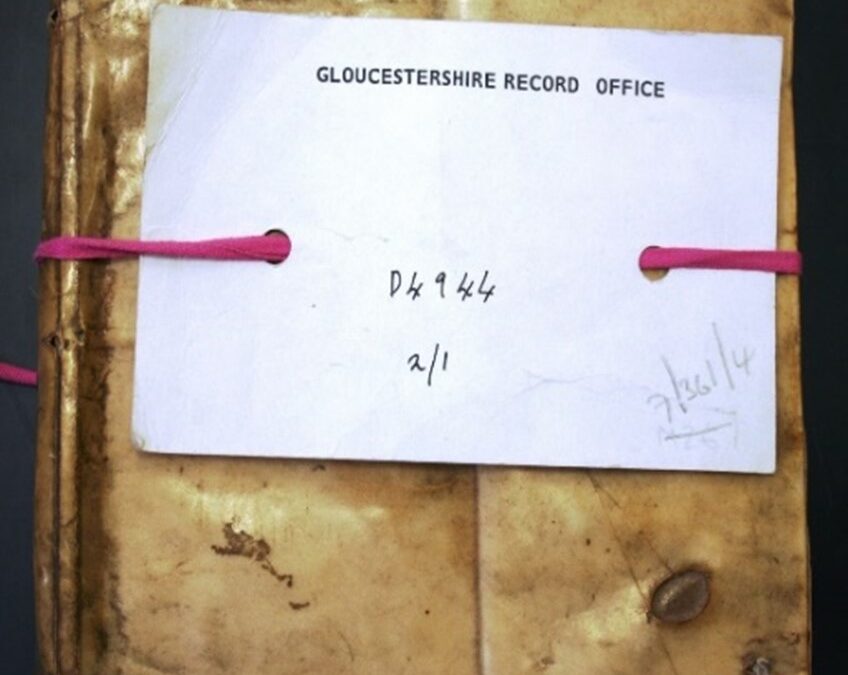
Nestled within Gloucestershire Archives you can discover the Minute Book used by the Tewkesbury Baptists between 1655 to 1808. It is written in numerous and mostly anonymous hands, with no seemingly obvious order to the book’s entries. I fell intrigued with the social aspects of the book, when details on the members were forever enshrined within this tiny book’s pages. The story I wanted to explore concerned the Old Baptist Chapel Sinners, men and women whose ‘naughty’ indiscretions led to their expulsion from the congregation. I am sure you can already imagine what some of these sins were, such as fornication and lying. However, did you think of ‘walking disorderly’ or ‘great stubbornness’?
I want to share with you the history of a few of the characters that I discovered as I researched into the sinners of the seventeenth through to the nineteenth century. Some of the ‘naughty’ sinners after their expulsion made the decision to repent and re-join the congregation, while others were forever banished from the Chapel. But what exactly does it mean to be cast out of the congregation? In April 1656, this very question was raised and discussed by the Baptists in one of their meetings. This was the conclusion to their debate:
 “What ought to be the behaviour of a church: or each Member to the one noted [warned] or cast out? Wee Judg that our cariage [behaviour] to a person cast out of the church ought to be as towards a heathen or publican as in Matthew.18.17. If wee find him hardened & persisting in sinne then to leave him & take no more notice of him: then of another wicked person. But if wee find him willing to heare us & soe likely to be gained then to use such meanes as the scriptures affordeth for the regaining of him.”
That was not the end of their debate however; for they went on to discuss what should happen if a woman was cast out:
“If a woman have sinned & cast out of ye Church & God hath given her repentance undoutedly shee may manifest it in the Church.”
Despite the Baptists singling out women in terms of expulsion and repentance, the evidence does not suggest that women were more often sinning than their male counterparts were. The root of this gender prejudice lies at the feet of Eve for her fall in the Garden of Eden; thereafter, women were not only seen as weaker vessels, but also more susceptible to the devil and sinning in general.
Although the pastor was the figurehead of the congregation, all members had a right to voice their opinion during meetings, which did include women (to a certain degree). The whole church would discuss and agree upon a suspension, since the whole congregation would then have to publicly shun that individual until they were restored. When John Davies was dismissed for ‘improprieties of conduct’, Eleanor Smith and Elizabeth James absented themselves from the church for months as a sign of protest.
Thomas Nest
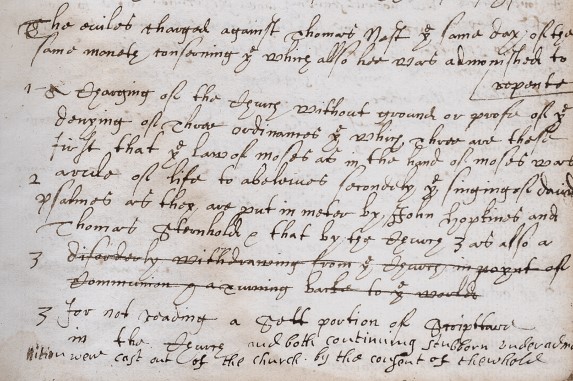
“The eviles charged against Thomas Nest… which also hee was admonished to repente. A Charging of the Church without ground or profe of ye denying of those ordinances… secondly ye singing of David psalmes as they are put in meter by John Hopkines and Thomas Sternhold & …. for not reading a Sett portion of Scripture in the Church and both continuing stubborn under admonition were cast out of the church by the consent of the whole.”
In the 17th century, Baptists were still divided over whether it was permitted to use music and words in hymns, and were against reciting psalms in unison. Thomas Sternhold (1500–1549) was an English courtier and the principal author of the first English metrical version of the Psalms, originally attached to the Prayer Book as augmented by John Hopkins. Thomas Nest’s attempt to sing the psalms was seen as a heinous sin by the Tewkesbury Baptists, as it was deemed a practice used by the Established Church.
An Meriman
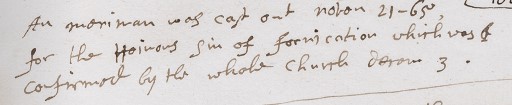
“An Meriman was cast out novem 21-65 for the Heinous sin of fornication which was confirmed by the whole church.”
Besides this notice of expulsion, An Meriman’s name appears once more in the Minute Book. She is listed among the 128 members of the congregation in 1663. The Baptists devised a secret code to protect their members’ identities during this time of persecution. After her expulsion, Sister Meriman’s name was crossed out from the list, so the Baptists deliberately went back through two years of records in order to remove her from the paperwork. There is no record that An Meriman ever returned to the congregation after this fateful punishment.
Frances Walker

“Frances walker was cast out Decem the 12 – 65 for lying, for casting of the practice of Gods ordinances & for great stubbornesse in her cariyo under Admonition, & for suspicion of fornication.”
In the following years, other members of the congregation committed every one of Frances Walker sins. The characteristic of being stubborn was often associated with women, who were deemed as being ignorant of not knowing their faults and when they should repent. Just like An Meriman, Frances Walker had her name scratched out from the list of congregation members.
Elizabeth Gwinet

“Elizabeth Gwinet was put by her place in the Church upon the dissatisfaction of the Church for her not receiving their admonition and for her marrying Contrary to Gospell order. And again upon the acknowledgment of her sinn and evill in these things shee was admited unto her place againe which admitance was agreed upon at a Church meeting in Tewxbury the 3 day of the 7th month 1691.”
Marrying contrary to the gospel refers to marrying a non-Christian, which can be seen in Corinthians 7:39, “she is free to marry anyone she wishes, but he must belong to the Lord.” However, it would have depended on the individual Baptist congregations the punishment for marrying someone from another Christian denomination, such as the Established State Church. In 1729, a Sister Gwinet is recorded as dead, could this be the same Elizabeth decades after her punishment? Unfortunately, there is no surviving evidence that Elizabeth Gwinet was buried in the Baptist graveyards in Tewkesbury.
Thomas Bishop

“Thomas Bishop cut off for drunkenness and swearing.” [21st October 1764]
In October 1752, Thomas Bishop had been ordained a Deacon alongside Isaac Strafford and Edward Ransford, by Mr Jones, Mr Haydon and Mr Ash. Deacons Strafford and Ransford remained within the congregation until their deaths, while Thomas Bishop did not repent his sins.
John Davies
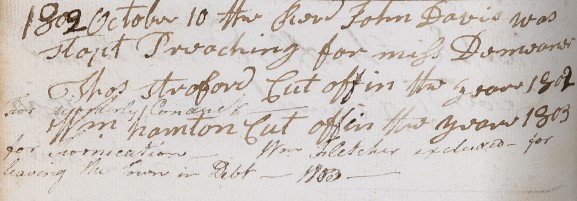
“Revd John Davies was Stopt Preaching for missdemener.” [10th October 1802]
In October 1791, John Davies came to preach at the Tewkesbury church for six months. After which, it was unanimously agreed for him to become the next pastor. He left his church at Moleston in Pembrokeshire to become the Pastor of Tewkesbury in May 1792.
He was dismissed for ‘improprieties of conduct’, although these were not expressly outlined in the book. The congregation swelled under his leadership; however, he was accused of baptising people irrespective of how devout they were.
Conclusion
I hope you have enjoyed this blog concerning the lives of the congregation, this is only a small portion of our Sinners Exhibition that was on display this year. There is still much more to discover in this little gem of a book. If you have the time, and are interested in social or religious history, then please look through the Minute Book on our interactive (located in the Old Baptist Chapel), the John Moore Museum website or in Gloucestershire Archives.
Recent Comments