
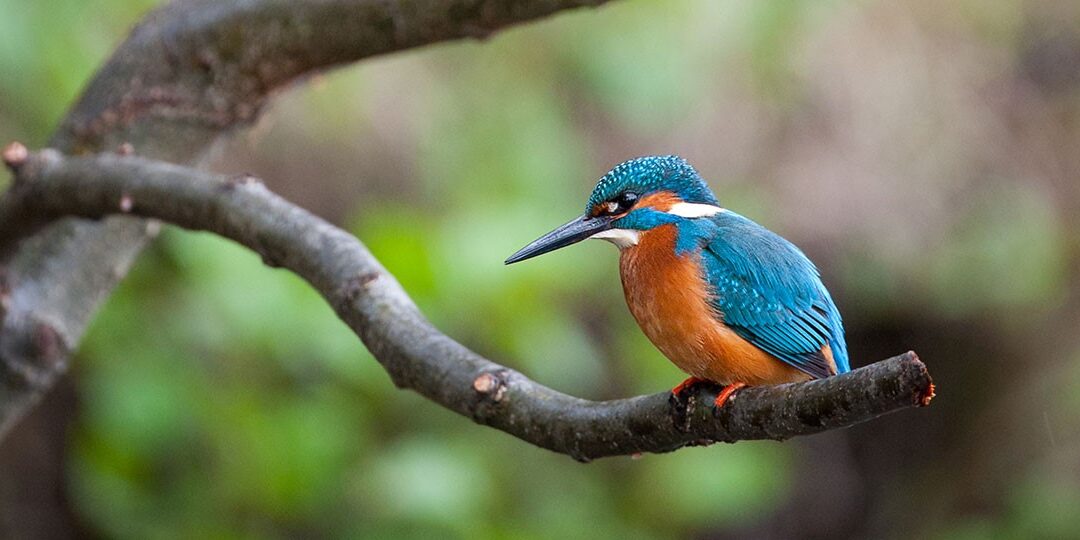
Kingfisher (Alecdo atthis)
By Chris Thorley
Description
If you are walking by a river or lake and see a flash of colour fly by then you can be sure that it is a kingfisher. Kingfisher species worldwide are known for their brightly coloured iridescent feathers and the common kingfisher, the only kingfisher species in the UK, is no exception, being clad in beautiful blue and orange feathers. The common kingfisher is a small bird. They are only slightly larger than a robin but is twice as heavy. They are around 16cm long with a 25cm wingspan. Their dagger shaped bill inspired the design of the Japanese bullet train. The female is identical to the male except that the lower part of her beak is orange with a black tip (as opposed to all black in the male)
Habitat
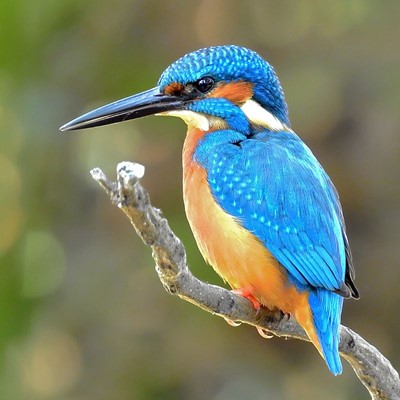
They are elusive and not often seen on an overcast day but the sun flashing off their feathers makes them easier to see when the sun is out. Occasionally they may be seen perching or diving for fish. It is not uncommon to see a birdwatcher with binoculars or a camera waiting for a good sighting of a kingfisher. They can be found around still or slow moving water. Rivers, lakes, canals, wetlands and even large ponds are all places where you might see a kingfisher. They are found across all low lying areas of the UK and Ireland. If the water is dirty or too fast moving it will be unsuitable for kingfishers to hunt there. A kingfisher will tend to have a territory covering a kilometre (0.6 miles) but can be up to 3-5 km (2-3 miles). A bonded kingfisher pair will divide territory between them.
Taxonomy
Worldwide there are 116 species of kingfisher which are present on every continent apart from Antarctica. Most are small birds, with the laughing kookaburra being a notable exception. In the UK however kingfisher refers to our only species, the common kingfisher. This species has a huge range itself being distributed throughout Europe, Asia and North Africa.
Diet
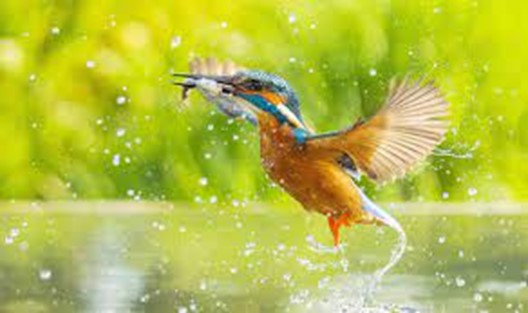
The main part of the kingfishers diet is small fish such as minnows or sticklebacks but will also eat tadpoles and water dwelling invertebrates including small prawns and crabs when found nearer coastal environments. A dive for prey is usually no deeper than 25cm (10 inches) the kingfisher will return to its perch with the catch and beat it several times against the perch to kill it then swallow it whole head first. Most of the fish it eats won’t be longer than 23mm, but it can swallow a fish up to 80mm in length.
Lifespan
Most live for around 1 to 2 years. Only half of young birds survive more than 2 weeks after leaving the nest and only a quarter survive to breeding age. Only a quarter of adult birds survive from one breeding season to the next.

Nesting
Kingfishers nest in a burrow dug in the bank of a stream. The nest tunnel is usually 60-90cm long. Pairs of kingfishers bond around February and then a clutch of 6-7 eggs are laid around March to April. Both parents take turns incubating the eggs which hatch after 19-21 days. Chicks are born altrical (without feathers.) Each chick can eat 12-18 fish a day. Chicks are often kicked out of the nest by parents before they have learned how to hunt (which is a factor in low survivability for chicks.)
Predators and threats
If winters are too cold it can be difficult for kingfishers to survive (particularly if rivers and lakes they use for hunting grounds are frozen over.) Floods, such as the ones that hit Tewkesbury in 2007, can make fishing difficult and destroy nests. Nests can also fail due to human disturbance as adult birds won’t visit nests if human habitation appears nearby. If chemicals are dumped into water and are ingested by fish that the kingfisher would eat then this can kill them. Since they are so vulnerable to polluted rivers their presence indicates healthier waterways. They ideally need clear water in able to see fish to hunt. They may also be hunted by cats or have their eggs eaten by rats. Collisions with vehicles or windows are another threat. Despite these threats the population appears to be stable both in the UK and globally.
What can we do to help?
If you are have a pond in your garden and live near a waterway you may be lucky enough to have kingfishers visit. If you have a pond which is a suitable size and has small fish (that you don’t mind being eaten!) In harsh winters they may even visit a bird feeder if it has offal or suet. Since collisions with windows are a threat to kingfishers it is a good idea to put stickers on the windows to deter kingfishers from flying into them. In the long term kingfishers will benefit from the creation of new wetlands and the improvement of water quality generally.
Recent Comments