

Eels (Anguilla anguilla)
By Philip Burrows
The Environment Agency is working on (or completed by now) an eel passage at the Abbey Mill Sluice on the River Avon in Tewkesbury, so now is a good time to look at the life of these creatures. They have a legal obligation to provide an improved eel passage at Abbey Mill Sluice to comply with the Eels Regulations 2009 (England and Wales). For more information regarding the new eel pass, please click on the link to the Environment Agency’s website: https://consult.environment-agency.gov.uk/west-midlands/avon-severn-eel-pass-project/

Eels on land
The Elver Wars:
Gloucester fell out with Severn-side towns and cities further upstream in a dispute over the tiny, wriggling offspring of the European eel. For centuries the annual springtime arrival of elvers in the Severn provided people who lived along the river with a welcome and free source of food.
But by the latter half of the Victorian-era, Gloucester had developed into an industrial city with a greatly increased population and what had been small scale elvering in days gone by changed into a major operation. The result was a reduction in the number of elvers being left in the river to continue their migration, so the catch in Tewkesbury and Upton-on-Severn dwindled, while in Worcester it almost disappeared. This caused furious resentment.
The dispute took a new tack when the newly formed Severn Fisheries Board decided that in the interests of conserving stocks of elvers, fishing for them should be banned. A law was passed in 1874 making it illegal to take elvers from the lower Severn.
Now there was outrage on two fronts. Firstly all Severn-side towns and cities fulminated against the Severn Fisheries Board for bringing to an end what had been for many years considered a way of life. Secondly, all the other towns and cities continued to rail against Gloucester for causing the problem.
Questions were asked in the House until in June 1876, a three-day inquiry into the elver question took place with the outcome that elvering was once more allowed.
It continues to this day, of course, though you’re unlikely to find elvers for sale by the bucketful in local fishmongers as you did up until perhaps 25 years ago. Due to a variety of factors, overfishing being one of them, the quantity of elvers found in the Severn is but a shadow of what it once was.
The River Severn, the Mill Avon and River Avon are migratory routes for European eel, which is a protected species. Over the last 30 years, the number of juvenile eels returning to rivers has fallen by around 95% across Europe.
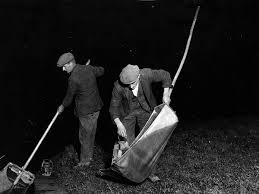
Elver fishermen
The Eels Lifecycle:
Eels first appeared over 65 million years ago, and they continue to thrive to this day. There exist over 800 species of eel throughout the world, and most populations show few signs of decay. Whether they live in fresh or saltwater, these ray-finned fish find a way to dominate their territory.
The eel can be found throughout British waters but is most encountered in larger numbers in slow-flowing rivers and still waters. Big eels though instead, go for land-locked still waters which are close to rivers and canals. Older eels which have been able to take advantage of all that the lake offers will be lurking in such lakes.
There are only two genuine species of eels which people may in the UK encounter – the silver eel and the conger eel. True eel species can be identified by their elongated body, a single fin that continues around the tail and the slimy, scale-less skin. Sand eels, eelpout and other eel-like creatures (such as wolfish, rockling and hake) are all fish species and not true eels. However, there are a few other species of genuine eel found in UK waters (such as the slender snipe eel and spiny eel species) which live at extreme depths.
Adult European eels have a broad diet that includes fish, molluscs, and crustaceans. They also scavenge on dead fish. The eel is also reported to leave the water and enter fields to feed on slugs and worms. Small eels feed on insect larvae and worms as well as molluscs and crustaceans.
The eel may have a snake-like appearance but is in fact a fish. European eels breed only once during their lifetime. Once spawning is complete, European eels die. Breeding season is from late winter to early spring. All eels hatch from tiny spherical eggs (between 2 and 10 million are laid) in the Sargasso Sea, in the western Atlantic Ocean and embark on a migration that will take between 1 and 2 years. The tiny eggs float on the sea currents and hatch into larvae, called leptocephali, (meaning slim head) which are about 5mm long. They float on currents towards Europe, on a journey that is over 6,500km.
By the time the leptocephali reach the continental shelf of Europe, they will have grown into a glass eel, and it is at this stage of the life cycle that they enter the river estuaries.
As they move up rivers, they develop into elvers. The elvers need to spread out within the river system and swim up tributaries to find suitable habitats and food to enable them to grow.
Once in the river system the elvers develop into yellow eels which are immature adults.
The yellow eel life cycle stage lasts many years and is spent within our rivers, before the eel becomes a silver eel. The silver eel only becomes fully mature during its migration back to the Sargasso Sea. Their average lifespan is 20 years but can reach 50 years and grow to 60-80 cm, although can reach 1.5 m in exceptional cases in length. It is this journey that the eel must make to enable it to spawn and complete its life cycle once it reaches the Sargasso Sea.
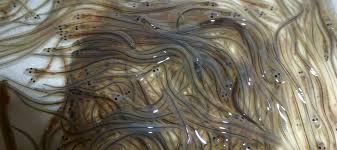
Elvers
John Moore quote:
This quote is taken from the book Man and Bird and Beast p238 – “The elvers, bootlace-thick eel-fry which swim up the river on the spring tides, are caught at night by our local fishermen in home-made cheese-cloth scoops; they sometimes take a hundredweight in an evening, that’s roughly 170,000 elvers – so a score of fishermen may kill three million in one night’s fishing. Nature is prodigal with them, and sends us every year an undiminished supply, all the way from the Sargasso Sea. The journey, incidentally, takes three years and involves a passage by entirely defenceless but highly nutritious creatures across 3,000 miles of ocean. The casualties must be enormous; and I always felt sorry for the unlucky ones who survived all those hazards only to finish up in Mrs. Sivell’s frying pan at the lower lode.”

Man and Bird and Beast
Very interesting read. My Dad (Tom Foxon) used to catch the elvers when he was the lock keeper many years ago at Upper Lode Lock which was a source of food and I believe some income for him.
That is an incredible family story and we are thrilled to hear that you enjoyed the blog.
I came across your site wanting to learn more and you did not disappoint. Keep up the terrific work, and just so you know, I have bookmarked your page to stay in the loop of your future posts. Here is mine at Webemail24 about SEO. Have a wonderful day!