

The Lion
By Gwilym Roberts
Visiting a zoo
Lions have always been my favourite animal. Renowned for being the most powerful big cat of them all. The King of the Jungle. Along with their beautiful golden manes, lions truly are amazing and beautiful animals. So I was naturally excited when I was younger to be going on a visit to the zoo. I was looking forward to meeting the king of the jungle, himself.
When I’d finally got to see the lion and his fine lioness, it was far from what I had expected to see. I was expecting to see the fiercely great and handsome beast–it would be the first time of ever seeing a lion with the naked eye, in-person–the king of the jungle and the king of the African plains. But what I saw instead wasn’t a king but a fallen warrior, with all hope gone. A gloriously huge lion, but a defeated one, at that. I remember the lion laying down, not all that far from me. It was the lioness that silently came towards me so we were looking at each other with the glass partition between us. The lioness looked directly into my eyes. I know we shouldn’t look any of the cats’ species’ in the eyes, be it big cats or household ones. To stare into a cat’s eyes acts as if you are challenging them; it is an aggressive act as if you’re perceiving yourself as a threat, a danger, even. They see it as confrontational. If you’ve ever seen household cats staring directly into the eyes of each other you’ll notice they give off a warning hiss. The first to break eye contact is the one that is attacked by the one that didn’t. For the cat that didn’t blink, he or she is the dominant one and, therefore, the one that blinked and broke off eye contact becomes weak in the other’s eyes, thus why they launch the first attack. It’s the same with big cats too.
So it was that the lioness and I made eye contact. She wasn’t challenging me, neither was I with her; I’m not that crazy. I know if the glass-partition wasn’t there, I’d be cat food; Big Cat food. It was like she wanted me to look into her eyes. What I saw was pain, misery, hopelessness, consigned to a fate that she’ll probably never see or feel freedom again. I had right then begun to understand that even animals suffer from mental health problems, from emotions. The lioness was depressed, no doubt about it. So was the king. I had begun to make my way to the exit, because I had seen enough, plus it was nearing the time I had to leave and journey back home. I remember the lioness going up to the lion while I was walking along the perimeter length of the enclosure. It was as if she had communicated with the lion, as he had, at that moment, risen his great fine head and turned to look at me. Both the lion and the lioness were watching me as I was walking away. I felt sympathy towards their situation, and I believe they felt it, too. I’ve never been back to a zoo since that day. Seeing those beautifully amazing animals in so much mental pain and suffering made me dislike zoos very much. On the other hand, some lions are bred in captivity and have no notion of the wild, and are therefore happy within their environment, since it’s the only one they know. There are organisations that release lions and other animals in captivity back into the wild.

Lion Classification
The lions are in a genus (a taxonomic rank used in the biological classification of living and fossil organisms, as well as viruses) of a group called Panthera, within the family of Felidae (big cats). The lion is Panthera Leo.
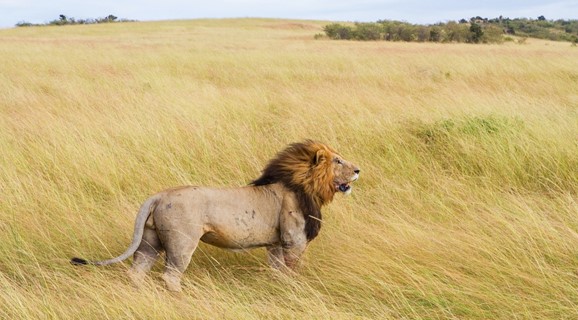
The lion has a muscular, deep-chested body, short rounded-head, round ears and a hairy tuft at the end of its tail. Adult male lions have prominent manes. There are only four big cats that can roar: Lions, Tigers, Jaguars and leopards. The lion holds the record for loudest roar. A lion’s roar is so loud that it can reach 114 decibels at a distance of around one metre and can be heard as far away as five miles. They are larger than the female. A lion pride consists of a few male adults and related females and cubs. Sadly, if the lioness has had cubs from the previous lion, the new alpha male will kill the cubs, thus wiping out the rival’s bloodline, so he can go about mating with the female for her to produce his bloodline. His heirs. His future bloodline sealed. Usually, a group of lionesses hunt together, preying mostly on large ungulates which are, primarily, a clad of large mammals with hooves, such as buffaloes. Buffaloes will let their weakest take a fall to succumb to a pride of lions attacking, so the rest of the herd can get away. If a lone lion was to hunt against a herd of African buffaloes, it would be suicidal. A buffalo can launch a lion six feet into the air from the sheer power and the strength in the neck, head and horns. Buffaloes have adapted to fighting back against lions, and they won’t hesitate to attack, to maim and even to kill, if there is no other alternative.
Lions have a love-hate relationship with hyenas; the feelings are mutual. Both are formidable opponents. Hyenas will take advantage of a lone lioness or her cubs, or be even braver by attempting to steal a lion’s kill. It’s not unheard of for a clan of hyenas to take down a fully grown adult male lion, although it is rare. Battle for territory and hunting grounds are mostly what brings these two fearless rivals into each others’ paths.
Lion Conservation
The lion ranges throughout Africa to Southeast Europe, and Western and South Asia. However, sadly, today it has been reduced to fragmented populations in sub-Saharan Africa, and one critically endangered population in Western India. On the IUCN Red List, it’s been listed as vulnerable. The lion population in African countries have declined by 43% since the early 1990s. Although the cause of the decline is not fully understood, habitat loss and conflicts with humans are the greatest causes for concern. There are those hugely involved in preserving the lion population so they don’t go extinct. These heroes are from organisations such as National Parks, Wildlife Preserves, and Private Reserves. Regional Conservation Strategies are in place thus creating Conservation Action Plans. Even some tribesmen in parts of Africa have resorted to hunting down poachers to scare them away or hold them for lawful arrest. African patrols, patrolling the savannahs and the plains looking out for poachers, protecting not just lions but for other animals, like elephants, too.
Organisations that help with the preservation of the lions’ population are as follows, and these are just a few:
Living with Lions – Maasai warriors and scientists work to conserve lions in Kenya’s unprotected areas.
Lion Guardians – Conservationist organisation working to reduce human-lion conflict.
Panthera – Project Leonardo. This organisation aims to increase African lion populations from 20,000 to a minimum of 30,000 over the next 15 years. Run and funded by African people and the Wildlife Fund. There’s a Big Cats Conservation Initiative in Northern Tanzania.
Desert Lion Conservation – This organisation is to allow scientific studies to conserve lions in the Namib desert in Southern Africa.
IUCN Cat Specialist Group – This organisation helps to develop management plans to promote felid (wild cat) conservation.
FelidTAG – This organisation is a Felid Taxon Advisory Group. It’s organized by the association of Zoos and Aquariums (AZA). AZA members and other felid experts participate in this organisation. They develop management plans to promote wild cat conservation and care of felids in AZA institutions.
These are the main ones listed. However, there are other organisations both in Africa and Asia and worldwide that helps in the preservation of the lives of endangered animals. Heroes don’t always wear capes. Whatever happens, we mustn’t allow the lions and other endangered species to become extinct. Lions play a huge role in the wild, as do other animals. I hope their numbers will increase so the king can roar triumphantly louder than ever. Lions are beautiful and amazing animals that should be appreciated and respected for the kings that they are. One must bow to His Majesty, the king of kings, the lion.
Enjoyed reading about the lion, lionesses and the current plight of this creature. You obviously have an appreciation of this creature and it shows through your passion and sympathy for them.
Thank you. I’m glad you enjoyed it. I love lions and have a passion for them.